
About this instrument
French master cello by Justin & Paul Diter, Marseille 1906
This beautiful French violoncello was made in 1906 in the joint workshop of the brothers Justin and Paul Diter in Marseille. It is a fine example of high-quality French violin making at the beginning of the 20th century and combines careful craftsmanship with an exceptionally powerful, dark and at the same time colourful sound.
Justin Victor Diter was born in 1866 in Mirecourt, one of the most important centres of French violin making. He trained with Paul Bailly, who in turn had worked with Jules Gaillard and later in the famous Paris workshop of Jean-Baptiste Vuillaume. Diter thus stood in a tradition of craftsmanship that decisively shaped French violin making in the 19th century. From 1890 to 1896 he worked for Paul Blanchard in Lyon before settling in Marseille.
His younger brother Paul François Diter, born in 1879, learned the craft of bow making with Charles Bazin in Mirecourt. From 1901 the two brothers ran their joint workshop in Marseille under the name “Diter Frères”. Their work is characterised by precise, elegant forms and a clear orientation towards the French school, in particular the models of J. B. Vuillaume. Besides carefully executed copies of classical models, the brothers’ instruments are known for their beautiful tonewood and their characteristic, often slightly shaded varnish. The workshop was later continued under the name “Diter & Lorange”.
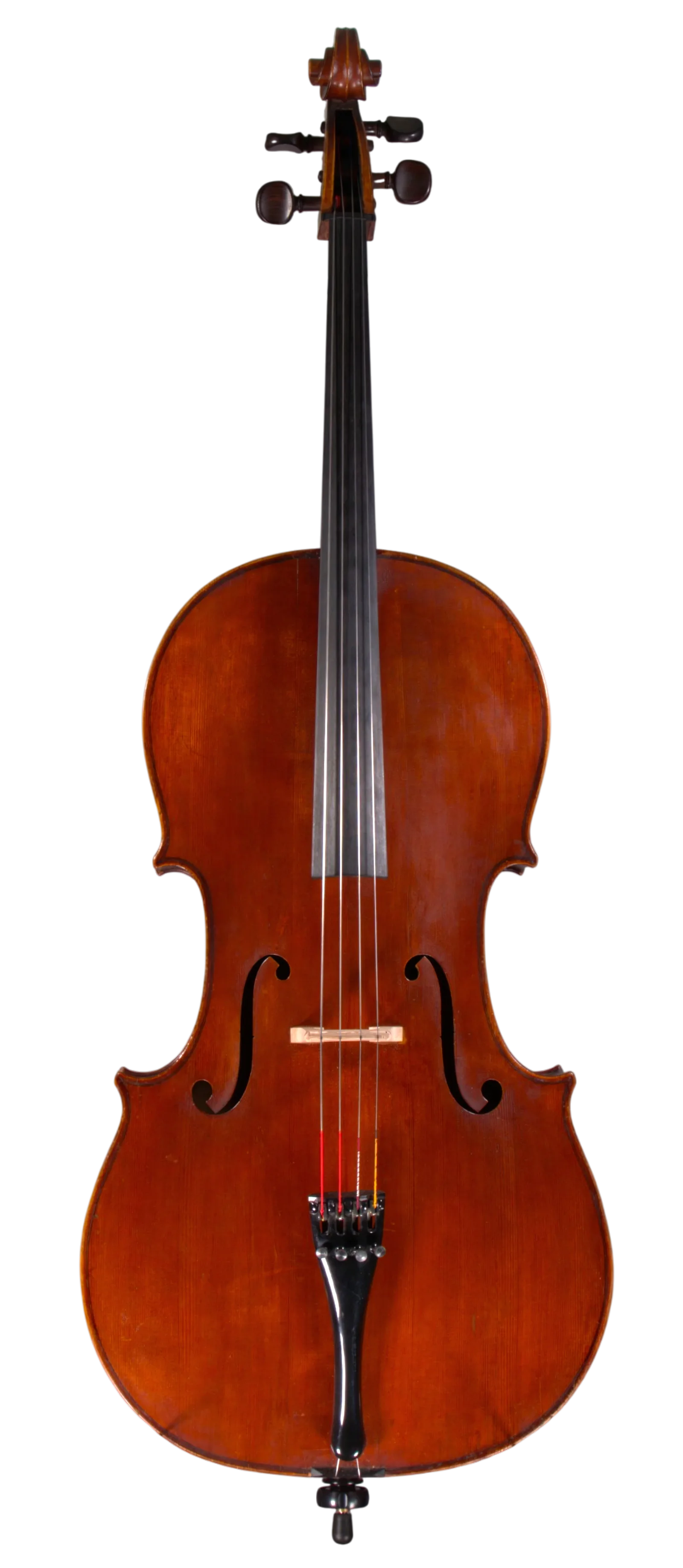
The violoncello offered here, dating from 1906, shows the high standard of craftsmanship of this workshop. It was built on a classical, harmoniously proportioned model whose elegant outline and balanced arching give the instrument a particularly beautiful appearance. The two-piece back is made of finely and densely flamed maple. The ribs and the carefully carved scroll also show attractive flame. The top of selected spruce has an even grain of medium width. The cleanly cut f-holes, the finely worked corners and the precisely laid purfling underline the quality of the workmanship.
Particularly beautiful is the warm, red to orange-brown varnish, which shows off the natural figure of the wood wonderfully. Its subtle shading lends the instrument additional depth and vitality. The signs of use that have developed over more than a century blend harmoniously into the overall picture and give the cello a matured, authentic character. Overall, it is in good condition.
Its real strength, however, is revealed when it is played. Tonally, it is a truly impressive instrument with an unusually dark, broad and powerful sound. Even with little bow pressure it responds effortlessly and develops a remarkable fullness of tone. The C string deserves special mention: it delights with a deep, dark, velvety and almost chocolatey sound. It has wonderful substance and depth without ever sounding heavy or sluggish.
In the other registers, too, the cello shows a most appealing tonal character. The sound remains full and carrying, gains warmth in the middle register and develops a beautiful, singing quality in the higher positions. The sound has that fine, distinctive timbre that is so highly valued in good French instruments. It is not simply loud or powerful but has a voice of its own, with a great deal of character and expression and a pleasing blend of warmth and clarity. It is precisely this combination of dark tone colour, easy response and a wide dynamic range that makes the instrument so interesting.
Another advantage is its comfortable playing dimensions. The cello has a standard string length and balanced proportions, so it plays naturally without any particular adjustment. The easy response allows both refined, nuanced playing and a powerful, carrying tone. The instrument therefore offers ideal conditions for demanding chamber music, for orchestral playing and for solo work.
This violoncello by Justin and Paul Diter from 1906 is a French master instrument of great character, convincing not only through its fine craftsmanship and its history but above all through its tonal qualities. Anyone looking for a cello with a deep, warm, decidedly dark sound that also responds easily and has great reserves of power should definitely try this instrument for themselves.
I would be delighted to welcome you in Hildesheim to get to know this violoncello in person and try it out at your leisure.