
About this instrument
An early English master cello, circa 1750.
An exceptionally fine-sounding 18th-century cello in a compact format.
This charming mid-18th-century English cello is an instrument with a unique presence. Circa 1750, it boasts over 270 years of history and today captivates with its notably warm, dark tone and remarkable ease of play. Its slightly smaller, compact proportions make it particularly suitable for musicians seeking a fully resonant cello with a shorter string length and comfortable playability.
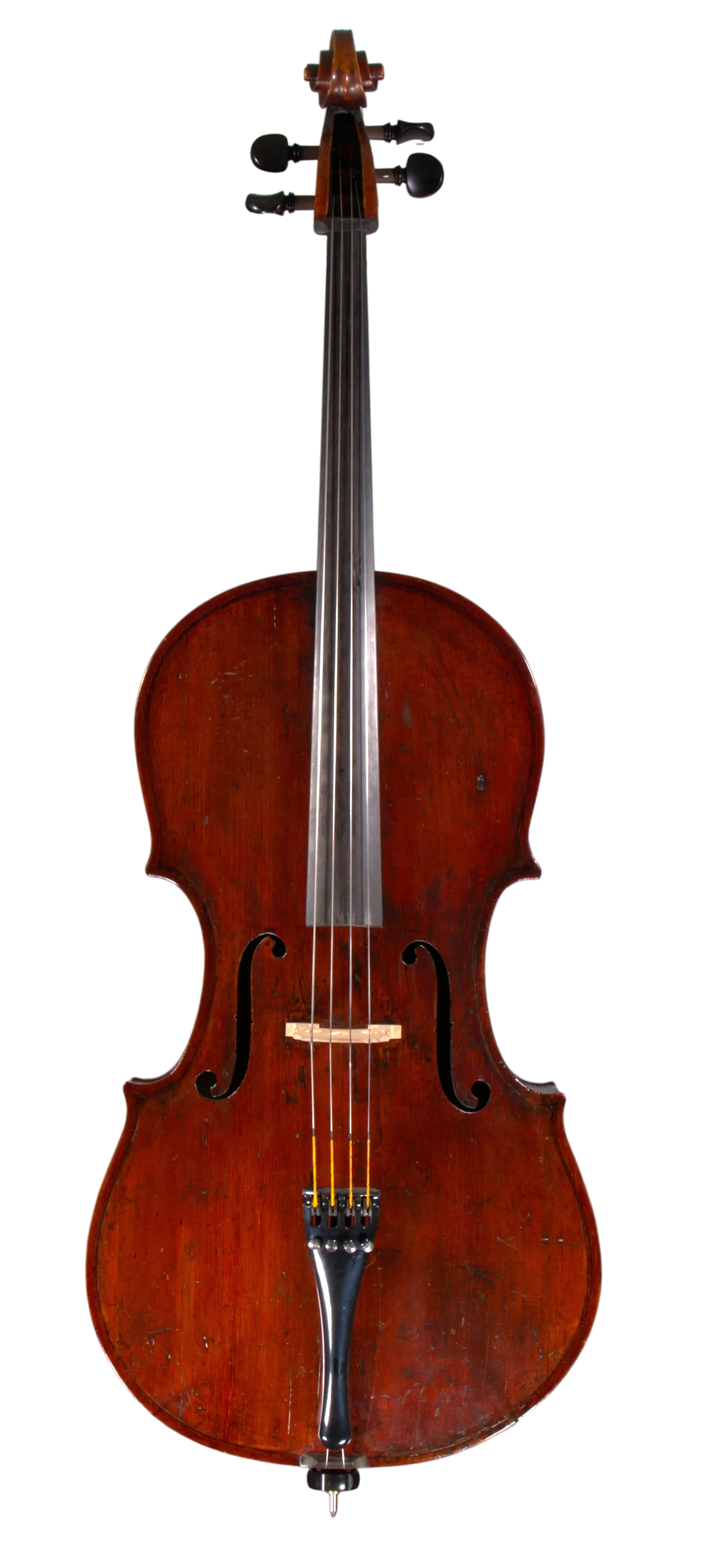
The instrument already possesses that unique charm externally that one so appreciates in old English stringed instruments. The softly curved outlines, the generously rounded upper and lower bouts, and the characterful, somewhat rustic workmanship give it a particularly sympathetic appearance. It is not an instrument that seeks to impress through exaggerated perfection, but one whose beauty lies precisely in its craftsmanship individuality.
The back exhibits a rather calm, subtle wood grain and is covered with a warm, gold to orange-brown varnish. The ribs possess a beautiful, lively patina, while the table presents itself in a darker, reddish-brown hue. Particularly charming is the interplay of these different tones, which have developed over many generations. The elegantly curved f-holes, the soft edges, and the expressively crafted scroll underscore the historical character. Numerous traces of its long life tell of an eventful past, without detracting from the cello's beauty.
The cello has been fully restored and is once again in a playable condition, having retained its wonderful old aura.
What sets this cello apart is its tone. It possesses an exceptionally warm, full and dark sound with a delightful chocolate hue. From the very first drawn notes, one notices how immediately and effortlessly it responds. One need not struggle to coax its sound. It reacts willingly to the bow, developing a pleasant fullness of tone and conveying a wonderfully natural playability.
Particularly appealing is the tonal warmth and the charming timbre. The sound has a fine, slightly veiled colour, yet it does not seem dull or static. On the contrary: the instrument exhibits a remarkable capacity for modulation. With subtle changes in bow pressure, speed and contact point, a wide range of tonal colours can be achieved – from soft and velvety to a more intense, expressive sound. This versatility gives the cello a unique voice and makes it musically very interesting.
This cello's tonal strengths lie primarily in chamber music and orchestral playing. It is certainly not an instrument designed for maximum volume and projection in a large concert hall. Instead, it possesses a quality that I personally value equally: a wonderfully cultivated, warm and colourful tone that integrates beautifully into an ensemble without losing its own character. For chamber music, it offers a particularly fine, high-quality sound.
Another significant advantage is its ease of handling. With a string length of only 37 cm and an overall more compact format, this instrument is particularly suitable for musicians who prefer a shorter string length. The reduced distances facilitate fingering and make shifting positions particularly comfortable. Thus, this cello is also an interesting alternative to a full-sized violoncello for smaller players or individuals with shorter arms and hands.
This old English cello is particularly appealing for its effortless playability. One takes it in hand, draws the first notes, and immediately feels at ease. It requires little force, responds sensitively to musical expression, and rewards the player with a warmth and richness of tone that one might not expect from an instrument of this compact size. It is one of those cellos that quickly inspires one to keep playing.
This English cello from around 1750 is an excellent instrument for musicians who prioritize tone colour, expression, and playing comfort over sheer volume. Its dark, chocolaty sound, fine modulatory capacity, and straightforward response make it an especially engaging companion for chamber music and orchestral playing.
An old cello with a warm, distinctive voice that above all brings immense joy to playing.
We invite you to visit us in Hildesheim to personally experience this remarkable instrument at your leisure.