
About this instrument
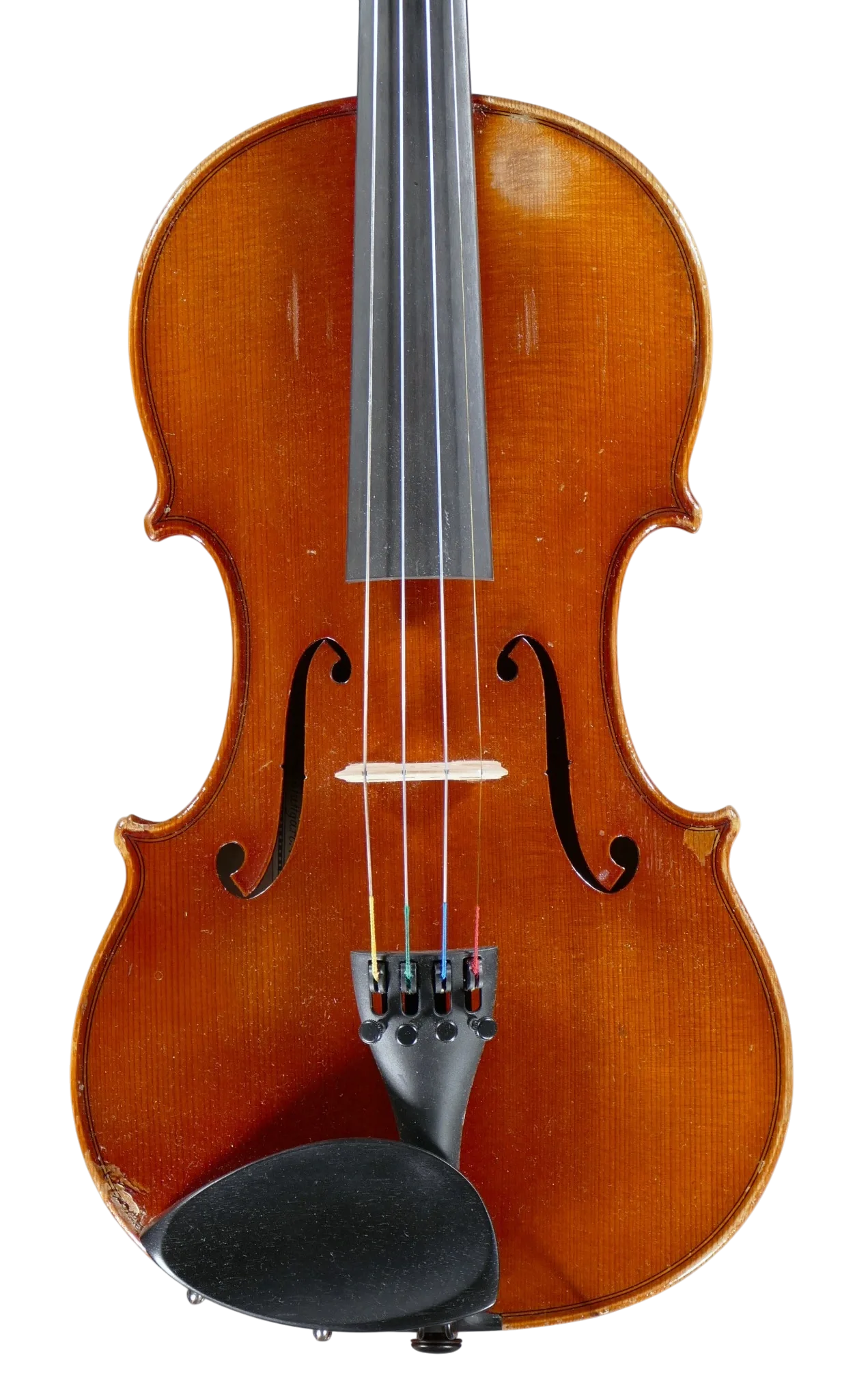
There are instruments that live through a century as if they had only just been taken out of the case. This violin by Friedrich Kochendörfer, Stuttgart 1925, is one of them: exceptionally well preserved, free of cracks and repairs, in a condition that comes very close to that of a new instrument – and still bearing its original label and its original brand stamp.
Friedrich Kochendörfer was born in Stuttgart in 1873. His father, A. F. Kochendörfer, was a zither maker; with him he learned the first skills of the craft before receiving his actual training at Schünemann's violin-making school. After years of apprenticeship and travel in various German cities, he settled in Stuttgart as a violin maker in 1895, succeeding his father. Only a year later he was awarded a silver medal at the Stuttgart art exhibition. In 1903 he was appointed teacher at the famous violin-making school in Mittenwald, which he later headed as director until his retirement in 1922. The Stuttgart business on Karlstrasse was carried on by various members of the family, and his younger brother Paul Kochendörfer also worked in Stuttgart as a respected master violin maker. Lütgendorff describes Friedrich as a maker who worked mainly after Stradivari, Guarneri and Maggini, and calls his varnish "reddish-yellow" – a tone you recognise in this violin at once.
Friedrich Kochendörfer died in 1923 – and this is where the small mystery of this violin begins, for its label bears the date 1925. In my assessment, both label and brand stamp are original. The most likely explanation is that the violin was begun during his lifetime and completed within the family after his death, possibly by Paul, who carried the Stuttgart tradition forward. How close the two brothers' work was is shown by a violin documented at Christie's bearing Paul's label dated 1924: it too has a one-piece back of broad curl and an orange-gold varnish, and it too is branded inside. Nobody can prove the exact course of events today, and I do not wish to present it as fact. What I am certain of, however, is that this violin genuinely dates from that period and is an exceptionally carefully crafted master work.
Hold it up to the light and the first thing you see is the one-piece back of beautiful cloud maple: its broad, lively flame drifts across the wood like clouds across a summer sky and continues into the ribs. The spruce top shows fine, even grain in the centre, widening slightly towards the flanks. The model and outline are classical and balanced, the f-holes elegantly and precisely cut, the edges and corners cleanly worked and the purfling set with a steady hand. The scroll, of plainer maple, is cut with strength and clarity, its turns deeply carved. Over all of this lies a glowing, transparent golden-orange oil varnish that deepens to a reddish hue on the scroll and brings out the structure of the wood even more. Apart from a few fine traces on the back, it has survived remarkably intact.
Its remarkably fresh appearance does not speak against its age. I have had many violins in my hands that spent almost their entire lives in their cases, were hardly played and were treated with the greatest care – and this one gives exactly that impression.
Its sound is open, radiant and soloistic. It responds very easily and immediately, projects clearly into the room and leaves the player plenty of tonal flexibility to find their own colours. This makes it a violin for anyone looking for an instrument with presence and brilliance, whether as a soloist, in chamber music or in the orchestra.
A violin outstanding in sound and appearance, in exceptional original condition and with a story worth telling. Anyone looking for a German master violin of this period should definitely play it for themselves. You are warmly welcome to visit me in Hildesheim and let its radiance convince you.