
About this instrument
Vienna, 1874. In the year after the great World Exhibition, when the city had presented itself to the world as a capital of music, this violin was made in a workshop on the ground floor of the new Musikverein building. Its maker, Gabriel Lemböck, was at that time Imperial and Royal Court Instrument Maker, worked for the conservatory of the Gesellschaft der Musikfreunde and stood at the height of his career. This violin was made by him personally – not a workshop piece, but an instrument from his own hand, and from exactly the period before 1875 from which his violins are most sought after today. Whoever picks it up holds a piece of Viennese musical history – and a voice one does not easily forget.
Lemböck's road to Vienna began in Hungary. Born on 16 October 1814 in Ofen, today's Budapest, he began his apprenticeship on 13 June 1828 with Johann Baptist Schweitzer in Pest, one of the most important Hungarian violin makers of his day; an apprenticeship with Peter Teufelsdorfer, often mentioned, is not supported by any documents. Around 1840 he came to Vienna, where in 1841 he is recorded as a journeyman with Anton Fischer, later his father-in-law. That same year he received his trade licence and opened his own workshop in the Mariahilfer Straße. In 1855 he took over the business of Bernhard Stoß in the Grünangergasse, in 1863 he was appointed Imperial and Royal Court Instrument Maker, and on 10 May 1870 he moved into his atelier at Canovagasse 4, in the newly completed Musikverein building – at the very heart of Viennese musical life. There, like his father-in-law before him, he worked for the conservatory. His pupils included Hermann Voigt, Alexander Ferency and August Setzer; in 1893 Carl Haudek took over the workshop, which still exists today. Lemböck died in Vienna on 27 March 1892, and the obituaries in the Viennese newspapers show how highly he was regarded.
His reputation was international even in his lifetime. He received awards in Munich in 1854 and London in 1862 as well as silver medals at the Paris World Exhibitions of 1855 and 1867 – not without pride, he called himself on his labels "holder of all World Exhibition medals". He comes particularly alive in a report by the Viennese music critic Eduard Hanslick from the Paris World Exhibition of 1878: Lemböck had exhibited an entire quintet after Stradivari there, the Parisian violinist Armingaud played his violins before the jury to loud applause, and the two Austro-Hungarian jurors considered them worthy of a gold medal. Josef Hellmesberger, the leading Viennese violinist of his time, played one of his instruments, and the great Hungarian violinist Ede Reményi obtained violins from him around 1862. His copies of Paganini's "Cannone" by Guarneri del Gesù are famous; alongside them, his surviving ledgers for the years 1870 to 1891 record 30 instruments after Stradivari, 16 after Maggini and 26 after Guarneri. Scholarship has, however, disproved one persistent legend: it was not Lemböck but Nicolaus Sawicki who repaired Paganini's Guarneri in 1828. The newspaper archive of the Austrian National Library holds almost fifty articles about him from 1845 to 1951, and to dig even deeper, in November 2026 I wrote to the Vienna City and Provincial Archives, the archive of the Gesellschaft der Musikfreunde, the Haus-, Hof- und Staatsarchiv and the Budapest City Archives.
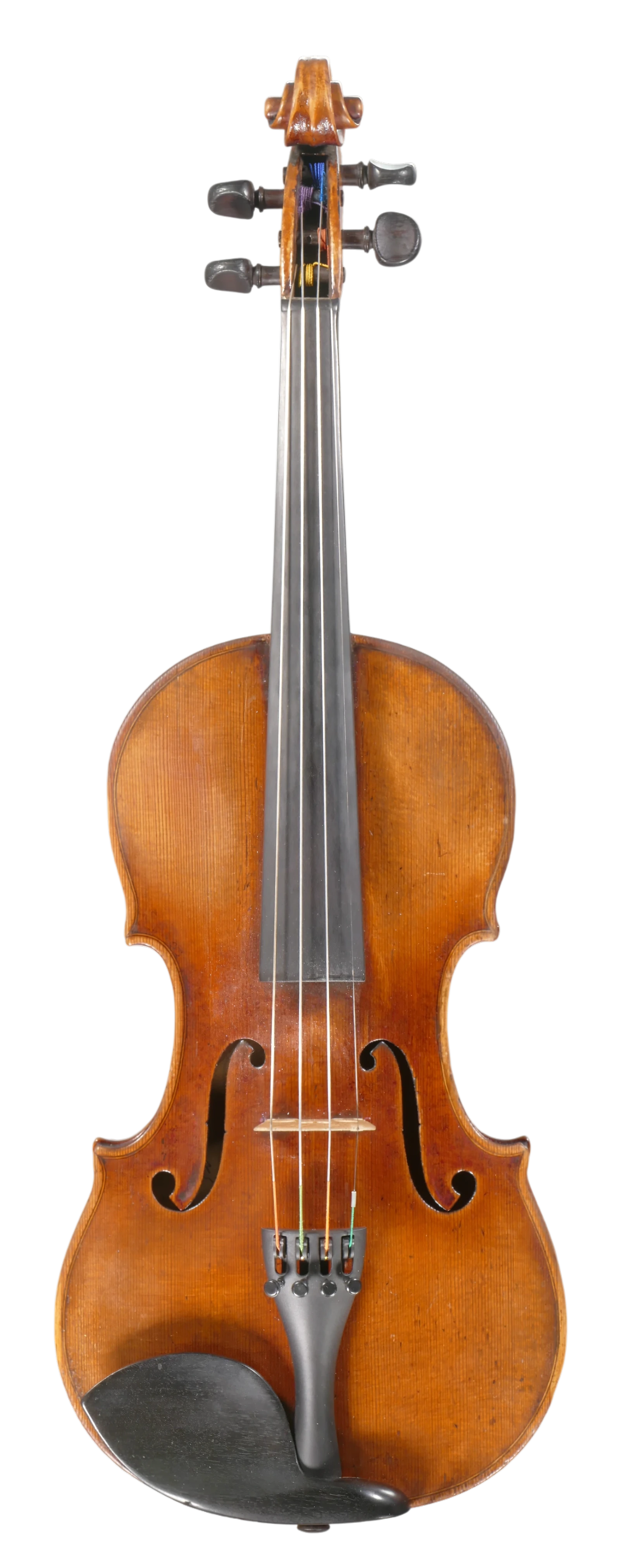
This violin is one of his Stradivari models and shows Lemböck exactly as one would hope: a disciplined, elegant craftsman with a sure eye for form and wood. The outline is balanced and classical, the C-bouts beautifully curved, the corners finely worked. The top of fine-grained spruce carries a deep red-brown varnish that glows warmly in the light, and the f-holes are cut with flair and precision. Turn the violin over and it becomes festive: the back of boldly and evenly flamed maple lies beneath a glowing golden-orange varnish, and the flames seem to move across the instrument with every turn. Ribs, neck and scroll are made of equally beautifully flamed wood; the scroll is deeply and cleanly carved and gives the head of the violin a confident, noble expression.
Inside is Lemböck's printed label "Kais. Königl. Hof-Instrumentenmacher, Gabriel Lemböck, Besitzer aller Weltausstellungs-Medaillen, Wien 1874, I. Canovagasse Nr. 4", with the year written in by hand with a dip pen. On the outside of the lower rib, to the left and right of the end button, are the two brands "G" and "L" with which he marked his instruments. Label, brand and address match exactly. The varnish and edges show the honest traces of some 150 years of music making – not a flaw, but the testimony of a long life on stages and in music rooms. A soundpost crack in the top has been superbly restored; the violin is professionally set up and ready to play. The body length is 35.6 cm, and a certificate by Hieronymus Köstler, Stuttgart, is in preparation.
And then this sound. This violin is a true soloist: it has immense power and projection and carries effortlessly over an orchestra without ever having to be forced. At the same time its tone is wonderfully balanced – from the sonorous, warm depth of the G string through the singing middle registers to the radiant, clear heights of the E string, the sound flows as if cast in one piece, without break and without weakness. Over everything lies a great warmth that makes the tone round, colourful and noble and never lets it become hard, even in fortissimo. It is this rare triad of soloistic stature, balance and warmth that makes one marvel at the very first stroke – and one understands at once why the Viennese violinists of the nineteenth century valued Lemböck so highly.
This makes it an instrument for musicians seeking a voice with personality: for solo performance as much as for chamber music or the orchestral desk, wherever carrying power and beauty of sound should come together. Anyone looking for a Viennese master violin from the finest period of a court instrument maker should definitely play this violin for themselves. I warmly invite you to get to know it in person at my showroom in Hildesheim and try it at your leisure.