
About this instrument
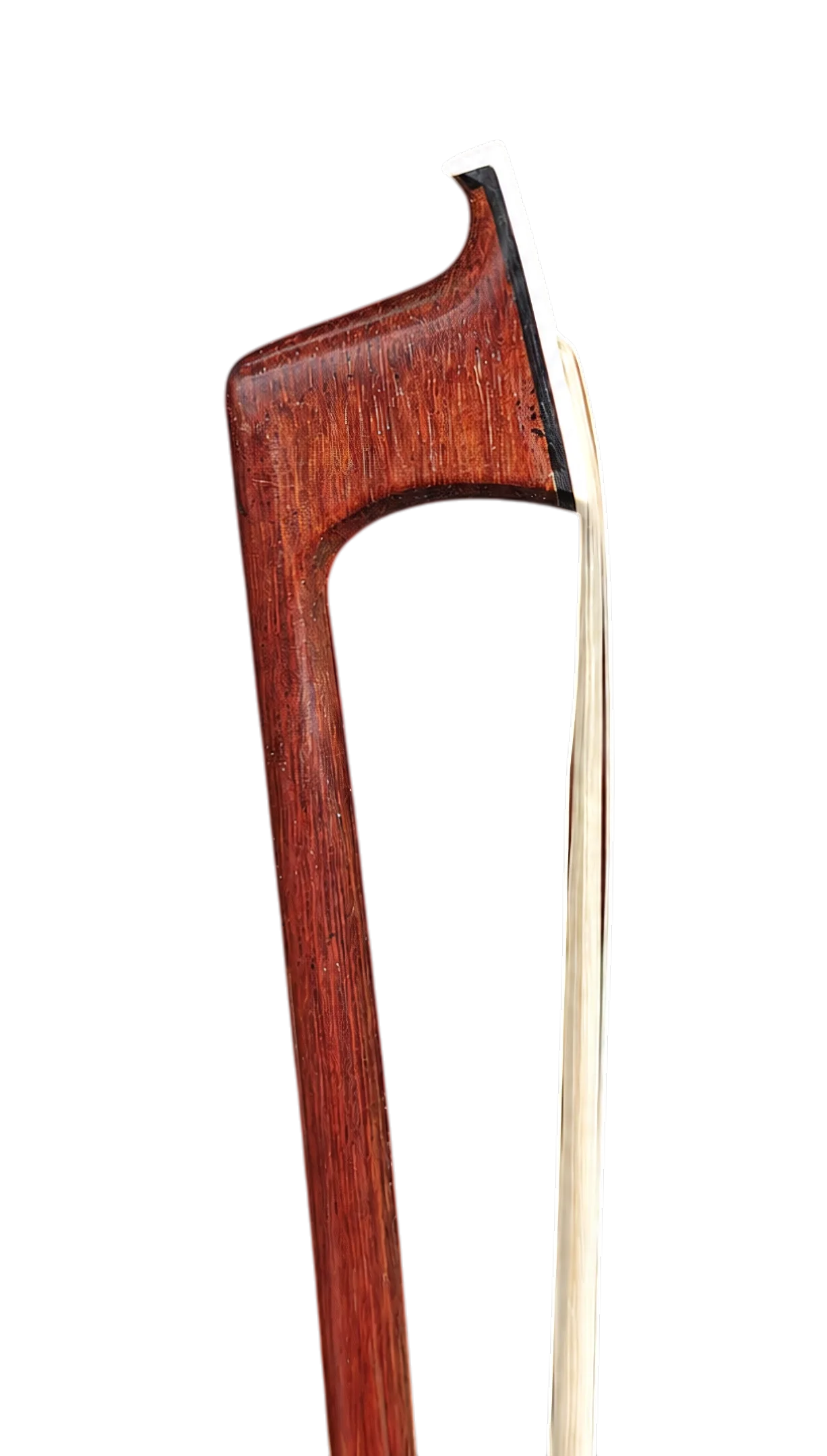
A good bow is like a second breath for the violin – and this one makes it blossom. François Peccatte made it in Mirecourt around 1845, and it captivates with its expressive workmanship and a particularly beautiful pernambuco stick: the round stick shows a lively structure and a warm colour, and Pierre Guillaume expressly highlights the beauty and rarity of this wood in his certificate. The strong, distinctively cut head bears the maker's typical hand, and a classic ebony frog with a simple pearl eye and nickel-silver mounts completes the characterful picture. François Peccatte (1821–1855) was the younger brother of Dominique Peccatte and an important representative of 19th-century French bow making. After training in the Mirecourt area he worked for a time with his brother in Paris before returning to Mirecourt in 1842; Dominique's influence is clearly felt in his powerfully shaped heads and decisive forms.
Its real quality, however, shows in playing. It draws from the instrument those varied, finely graded tone colours one hopes for from a French bow of this name; the tone gains expression and a rich spectrum of overtones and can be shaped wonderfully. On a good instrument in particular, this Peccatte can open up possibilities that would remain hidden with another bow – a bow that doesn't merely accompany but lets an instrument's personality come forward even more, and thus an attractive choice for solo work too.
A special feature is the small original wood insert in the middle section of the stick. It is not a later repair but was set in during making, possibly to compensate for a natural irregularity such as a knot. Pierre Guillaume expressly describes it in his certificate as a "pièce originale sans conséquence", an original insert without adverse consequences, and according to his additional information it affects neither value nor playing qualities. At 61.2 grams the bow has a very good, healthy playing weight, which can be reduced slightly with a lighter winding if desired. It is offered with a certificate of authenticity by Pierre Guillaume, Brussels, dated 14 March 2024, confirming it in all essential parts as an authentic work by François Peccatte. I warmly invite you to try it on your own instrument at my showroom in Hildesheim.