
About this instrument
You close your eyes, draw the bow across the C string – and believe you are holding a two-hundred-year-old Italian. Yet this exceptionally rare cello was made by Arnold Otto Schmidt in Mannheim around 1930, as a finely conceived copy after Ruggeri. Its provenance alone is special: I was able to acquire it directly from the estate of the Schmidt family. Cellos by this maker are extremely rare today; even in the large auction archives only a few of his instruments are documented, mostly violins. Schmidt was born in 1897 in Markneukirchen into a family of violin makers, was the son and pupil of Anton Otto Schmidt, worked for E. W. Geipel in Mannheim and later set up on his own there; his activity in Mannheim is documented from 1917, and an advertisement from 1933 calls him "master violin maker Arnold Schmidt" with his "workshop for art violin making".
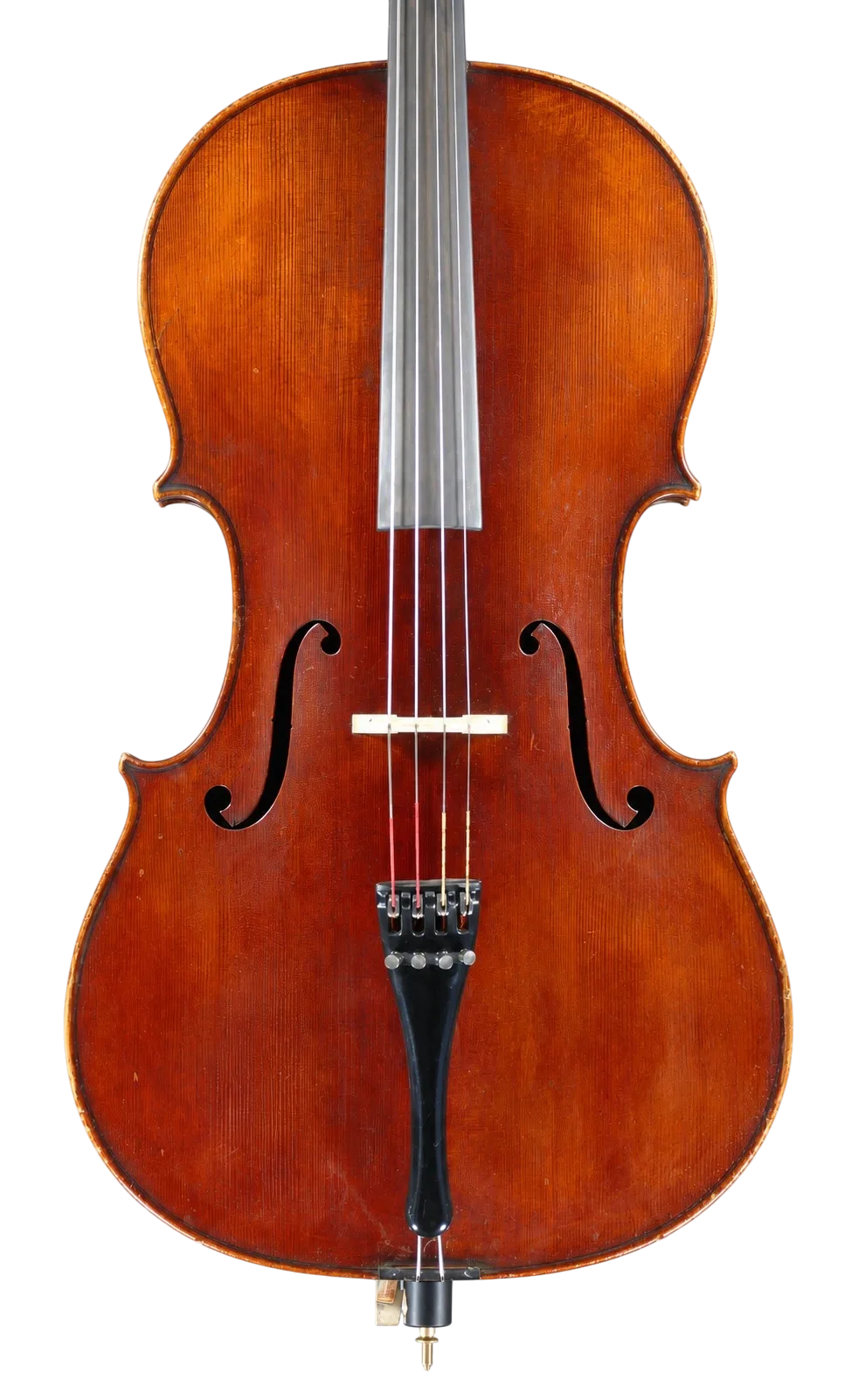
This cello shows how intensively he engaged with Italian models in his better work. Especially appealing is the poplar back, whose broad, lively, irregular structure gives it a completely different character from a strongly flamed maple back – calm and yet deeply individual. The ribs, by contrast, are attractively flamed and, together with the handsomely figured neck, form an effective contrast, and the top has a particularly beautiful, even spruce structure. A warm red-brown to amber varnish is harmoniously preserved and unfolds a natural depth, especially on the back and ribs. Elegantly cut f-holes, pronounced corners, the slender, balanced silhouette of the Ruggeri model and a powerful, individual scroll in dark red-brown varnish complete the picture. With a body length of only 74.5 cm the body is dainty and elegant, but Schmidt kept the usual playing measurements: the cello doesn't feel reduced, simply comfortable and easy to handle.
And in sound it surprises profoundly. You hear nothing of the compact body – on the contrary, its tone has a depth, warmth and maturity reminiscent of a much older instrument: dark and warm at its foundation, open and colourful, with the slightly dry, mature complexity one associates with good old Italians; the poplar back surely contributes to this very individual character. It responds directly yet is never one-dimensional, combines warmth, carrying power and a great palette of colours, and opens up under stronger bow pressure instead of turning hard – suitable for a big, characterful solo sound as well as for chamber music and orchestra. The cello is in exceptionally good, well-kept condition and for me one of the most interesting surviving instruments by this little-known Mannheim master. I warmly invite you to get to know it in person at my showroom in Hildesheim and to try it at your leisure.