
About this instrument
Its top contains wood that was already growing while the great masters were at work in Cremona – and you can hear it. Eric Blot attributed this characterful Italian cello to the Mantuan school around 1820. In my personal estimation, however, it could have been made considerably earlier, possibly as early as the middle of the 18th century. A dendrochronological analysis cannot determine an exact year of making, but its results are well compatible with an earlier date and impressively confirm the Italian origin of the top wood: the youngest clearly identifiable growth rings date from 1692 on the bass side and 1699 on the treble side, one or two further rings may lie at the joint, and both halves of the top come from the same tree. Remarkable are the many clear matches with the top wood of important Italian instruments of the late 17th and early 18th centuries – including instruments by or attributed to Pietro Giacomo and Giovanni Battista Rogeri, Andrea Guarneri, Giuseppe Guarneri filius Andreae, Guarneri del Gesù, Antonio Stradivari, Carlo Bergonzi, Giovanni Battista Guadagnini, Matteo Goffriller, Domenico Montagnana, Sanctus Serafin, Carlo Tononi, Alessandro and Nicola Gagliano, Michele Deconet and David Tecchler. This does not necessarily mean that the wood comes from the same tree, but it shows an exceptionally close relationship and points very convincingly to the same northern Italian-Alpine timber and trading region.
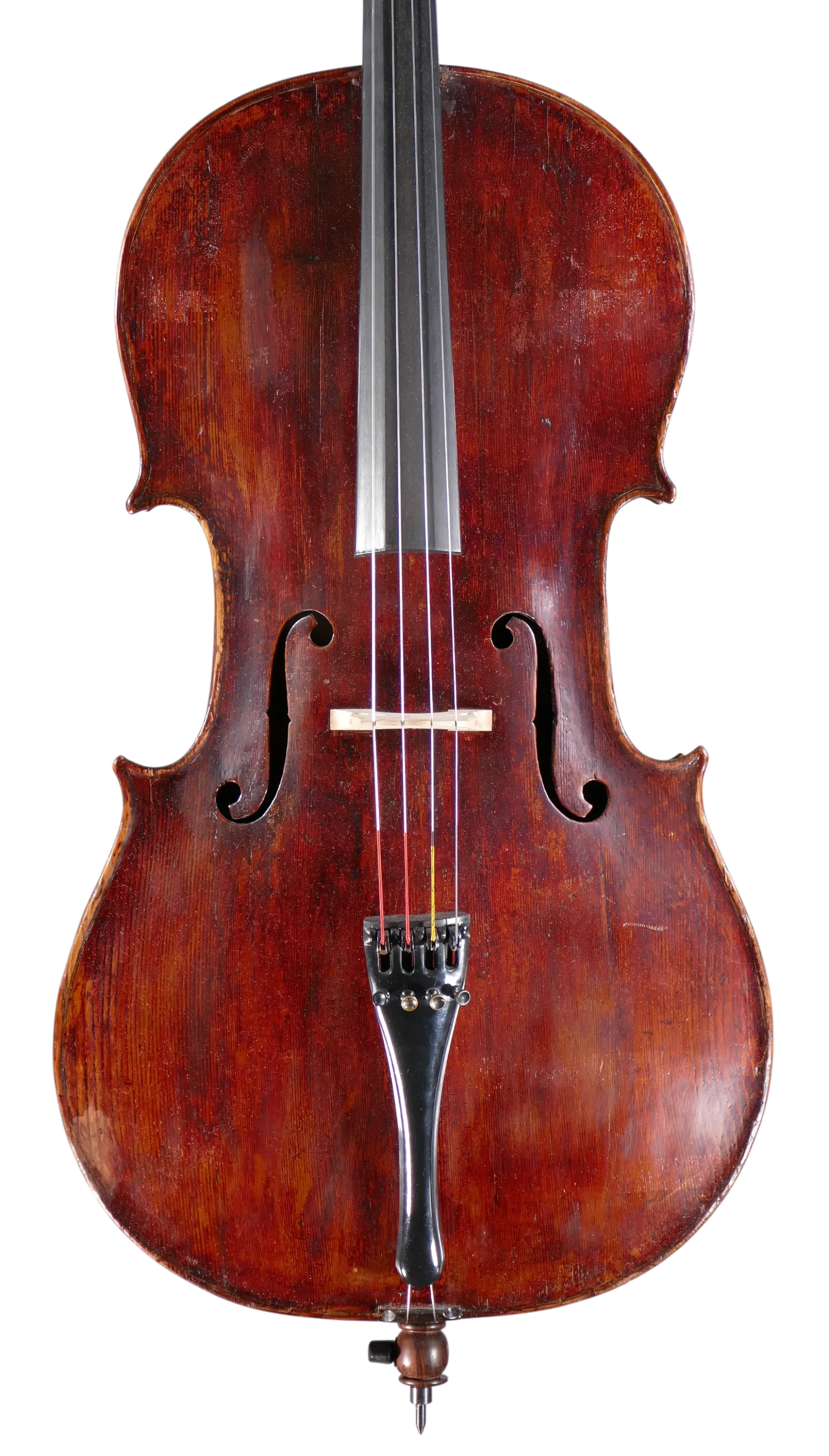
The model is comparatively dainty and elegant: narrow C-bouts, softly rounded upper bouts and a harmoniously flowing lower bout, together with long, somewhat idiosyncratically cut f-holes. The scroll and body show no exaggerated perfection, but a simple, direct and very personal hand of the kind found again and again in old Italian instruments. A deep red to red-brown varnish over a warm golden ground, a patina grown over centuries, natural signs of use and varnish preserved to varying degrees give the surface an exceptional liveliness. The two-piece back shows a fine, restrained figure beneath the dark, transparent varnish, the ribs carry the same intense red, and the powerfully carved scroll with its wide-open volute completes the historic picture.
In sound this cello is exceptional. Despite its simple construction it has enough power and volume to unfold effortlessly in the room; the bass is full, carrying and present without becoming heavy, and above all the rich, luminous overtones and that unmistakable tone colour found only in very old Italian instruments are fascinating. The tone has natural warmth, depth and a sweetness hard to put into words; it is dark at its foundation and at the same time radiant, colourful and immediate, and it reacts vividly to every bow speed and tonal idea. It is precisely the contrast between plain workmanship and stunning sound that makes it so appealing. Italian cellos of this age that are still affordable and offer such a level are very hard to find today – a rare opportunity. I warmly invite you to get to know it in person at my showroom in Hildesheim and to try it at your leisure.