
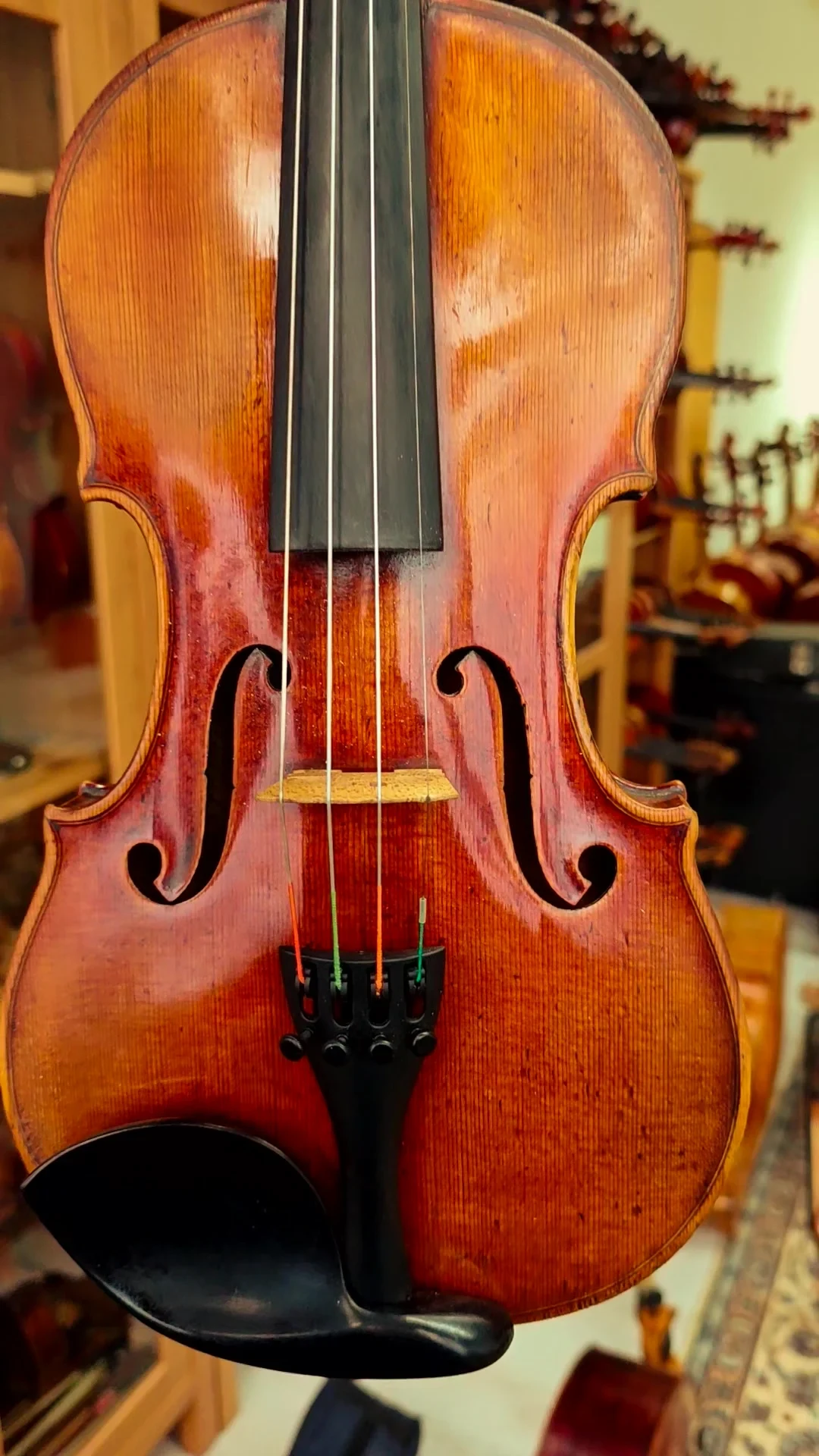
Some instruments arouse your curiosity with the very first stroke of the bow. That is what happened to me with a violin by Gabriel Lemböck from 1874 that has just arrived. Its tone is immense: powerful and projecting, yet warm, round and rich in colour. Reason enough to take a thorough new look at its maker, even though a great deal has already been written about Lemböck. Here I summarise what I found in reference works, old newspapers and other sources.
From Ofen to Vienna
Gabriel Lemböck was born on 16 October 1814 in Ofen, today's Buda, part of Budapest. On 13 June 1828 he began his apprenticeship in Pest with Johann Baptist Schweitzer, one of the most important Hungarian violin makers of his time. The apprenticeship with Peter Teufelsdorfer mentioned in many short biographies, by contrast, is not supported by any document. Around 1840 Lemböck moved to Vienna. In 1841 he worked there as a journeyman for Anton Fischer, his future father-in-law, and in the same year received his trade licence for his own workshop on Mariahilfer Straße.
In 1855 he took over the business of Bernhard Stoß in the Grünangergasse, and in 1863 he became Imperial and Royal Court Instrument Maker. On 10 May 1870 he moved into a workshop on the ground floor of the newly built Musikverein building at Canovagasse 4 and, like his father-in-law before him, worked for the Conservatory of the Gesellschaft der Musikfreunde. Lemböck died in Vienna on 27 March 1892. His workshop was taken over by Carl Haudek in 1893, and it still exists today.
Copies after the great Italians
Lemböck worked mainly after Stradivari, Guarneri del Gesù and Maggini. His copies of Paganini's "Cannone" are famous. For the years 1870 to 1891 alone, his surviving ledgers record 30 copies after Stradivari, 26 after Guarneri and 16 after Maggini. Josef Hellmesberger, the leading Viennese violinist of his time, played one of his instruments, and the Hungarian virtuoso Ede Reményi obtained violins from his workshop around 1862. Today Lemböck's violins from before 1875 are especially sought after.
What the sources reveal
On closer inspection, some often-repeated stories turn out to be legends. Paganini is said to have had his Guarneri repaired by Lemböck in Vienna in 1828. But in that year Lemböck was only just beginning his apprenticeship in Pest; the repair was done by Nicolaus Sawicki. His exhibition successes, on the other hand, are well documented: silver medals at the Paris World Exhibitions of 1855 and 1867, plus awards in Munich in 1854 and London in 1862. Not without pride, Lemböck described himself on his labels as "holder of all World Exhibition medals".
He comes vividly to life in a report by the Viennese music critic Eduard Hanslick from the 1878 Paris World Exhibition. Lemböck had exhibited an entire quintet after Stradivari. A member of the jury, the Parisian violinist Armingaud, played his violins to loud applause, and the two Austro-Hungarian jurors considered them worthy of a gold medal. For the viola and cello of the quintet, however, no one could be found in Paris to play them.
The digital newspaper archive ANNO of the Austrian National Library holds almost fifty articles about Lemböck from 1845 to 1951: exhibition reports, advertisements, news about his workshop and finally the obituaries of March 1892, among them one in the Neue Freie Presse of 28 March 1892. They show how present Lemböck was in the musical life of Vienna in his day.
The violin of 1874
The violin that set me on this search was made in 1874, the year after the Vienna World Exhibition and in Lemböck's best period. Inside is his printed label "Kais. Königl. Hof-Instrumentenmacher, Gabriel Lemböck, Besitzer aller Weltausstellungs-Medaillen, Wien 1874, I. Canovagasse Nr. 4"; the year is written in by hand with a pen. On the outside of the lower rib, to the left and right of the end button, are the brands "G" and "L" with which Lemböck marked his instruments. Label, brand and address fit together: he had moved into the workshop in the Canovagasse in 1870.
It is built after Stradivari's model, with a top of fine-grained spruce under a deep red-brown varnish and a boldly flamed maple back under a glowing golden-orange varnish. A soundpost crack in the top has been excellently restored. And then that tone: tremendous in power and projection, sonorous and warm on the G string, brilliant in the upper register and never harsh. You understand at once why the Viennese violinists of the 19th century valued Lemböck so highly.
The film and further details can also be found among the new arrivals: Gabriel Lemböck, Vienna 1874. The violin can be tried in Hildesheim by appointment.
The research continues
To dig even deeper, in November 2026 I wrote to four archives: the Vienna City and State Archives regarding his estate and trade records, the Archive of the Gesellschaft der Musikfreunde regarding the workshop in the Musikverein and his work for the Conservatory, the Haus-, Hof- und Staatsarchiv regarding the award of the court title, and the Budapest City Archives regarding his apprenticeship and family origins. As soon as answers arrive, I will add them to this article.
Sources: Oesterreichisches Musiklexikon online, "Lemböck, Gabriel"; Eduard Hanslick, report from the 1878 Paris World Exhibition; ANNO – AustriaN Newspapers Online; Tarisio Cozio Archive; label and brand of the instrument.