
About this instrument
Italian cello, Mantua, c. 1820 – attributed by Eric Blot
This characterful Italian cello was attributed by Eric Blot to the Mantua school, c. 1820. In my personal opinion, however, the instrument may have been made considerably earlier, possibly as early as the mid-18th century. Although dendrochronological analysis cannot establish an exact year of manufacture, its findings are entirely consistent with an earlier date and provide compelling confirmation of the Italian origin of the spruce used for the table.
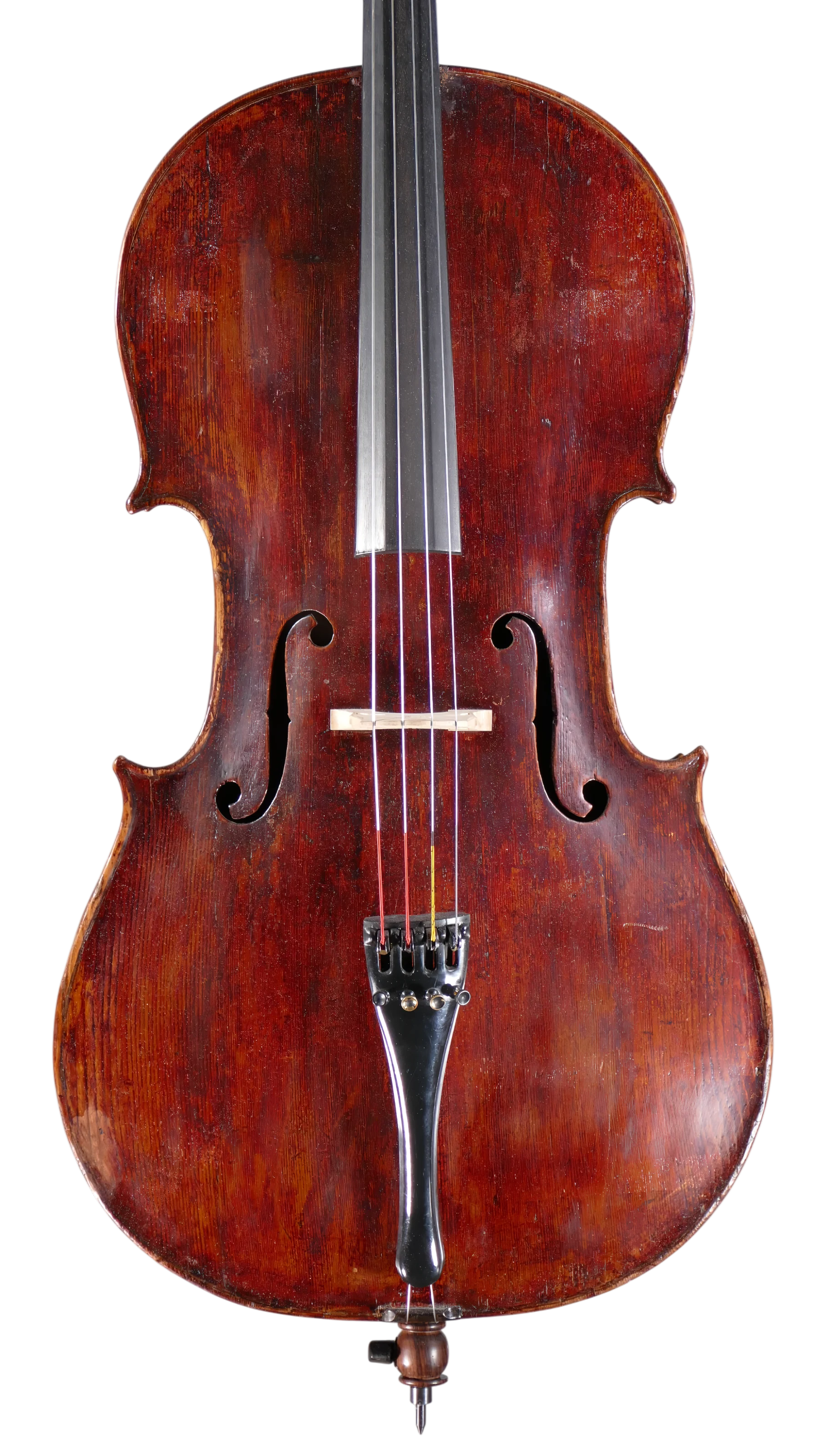
The cello has a comparatively slender and elegant model. The narrow C-bouts, softly rounded upper bouts and harmoniously tapering lower bout give the instrument a particularly appealing silhouette. The elongated, somewhat idiosyncratically cut f-holes accentuate its distinctive character. The workmanship of the scroll and body is likewise not marked by excessive perfection, but instead reveals a simple, direct and highly individual approach to craftsmanship of a kind repeatedly encountered in old Italian instruments.
Particularly striking is the deep red to reddish-brown varnish laid over a warm golden ground. The patina acquired over the centuries, the numerous natural signs of use and the varying degrees of varnish retention give the cello an exceptionally vivid surface. Beneath the dark, transparent varnish, the two-piece back displays a fine and rather restrained figure. The ribs also retain the intense reddish varnish and blend harmoniously into the instrument’s coherent overall appearance. The powerfully carved scroll, with its widely opened volute and similarly pronounced patina, completes the historic impression.
The dendrochronological analysis produced extremely interesting results. The youngest clearly discernible growth rings were dated to 1692 on the bass side and 1699 on the treble side; immediately adjacent to the centre joint, one or two additional rings may be present, though they cannot be identified with certainty. According to the analysis, both halves of the table came from the same tree.
Particularly noteworthy are the numerous clear matches with the table wood of important Italian instruments from the late 17th and early 18th centuries. Among the closest matches are instruments by, or attributed to, Pietro Giacomo and Giovanni Battista Rogeri, Andrea Guarneri, Giuseppe Guarneri filius Andreae, Guarneri del Gesù, Antonio Stradivari, Carlo Bergonzi, Giovanni Battista Guadagnini, Matteo Goffriller, Domenico Montagnana, Sanctus Serafin, Carlo Tononi, Alessandro and Nicola Gagliano, Michele Deconet, David Tecchler and other important northern Italian makers. Such matches do not necessarily mean that the wood came directly from the same tree as that used for these instruments. They do, however, demonstrate an exceptionally close dendrochronological relationship and point very convincingly to the same northern Italian and Alpine timber-sourcing and trading region.
Tonally, this cello is exceptional. Despite its relatively simple and unacademic construction, it possesses sufficient power and volume to project effortlessly through a space. The bass is full, carrying and present, without sounding heavy or inert. Most fascinating, however, are the rich, luminous overtones and distinctive tonal colour found only in very old Italian instruments.
The tone has a natural warmth, depth and a mellowness that is difficult to put into words. It is at once darkly grounded and radiant, richly coloured and immediate. The instrument responds vividly to different bow speeds and tonal intentions, while always conveying the impression of a resonant body matured over many generations. It is precisely the contrast between the comparatively plain workmanship and the overwhelming tonal result that gives this cello its particular appeal.
Italian cellos of this age that remain within a comparatively affordable price range while offering such a tonal level are now exceedingly difficult to find. This instrument therefore represents a rare opportunity to acquire an authentic, characterful Italian cello with fascinating dendrochronological documentation and a truly convincing sound.
A rare historic instrument of great personality, with fascinating dendrochronological documentation and a sound that embodies, in a particularly compelling way, the unmistakable warmth and tonal colour of old Italian cellos.