
About this instrument
Carlo Carletti – Pieve di Cento, c. 1920
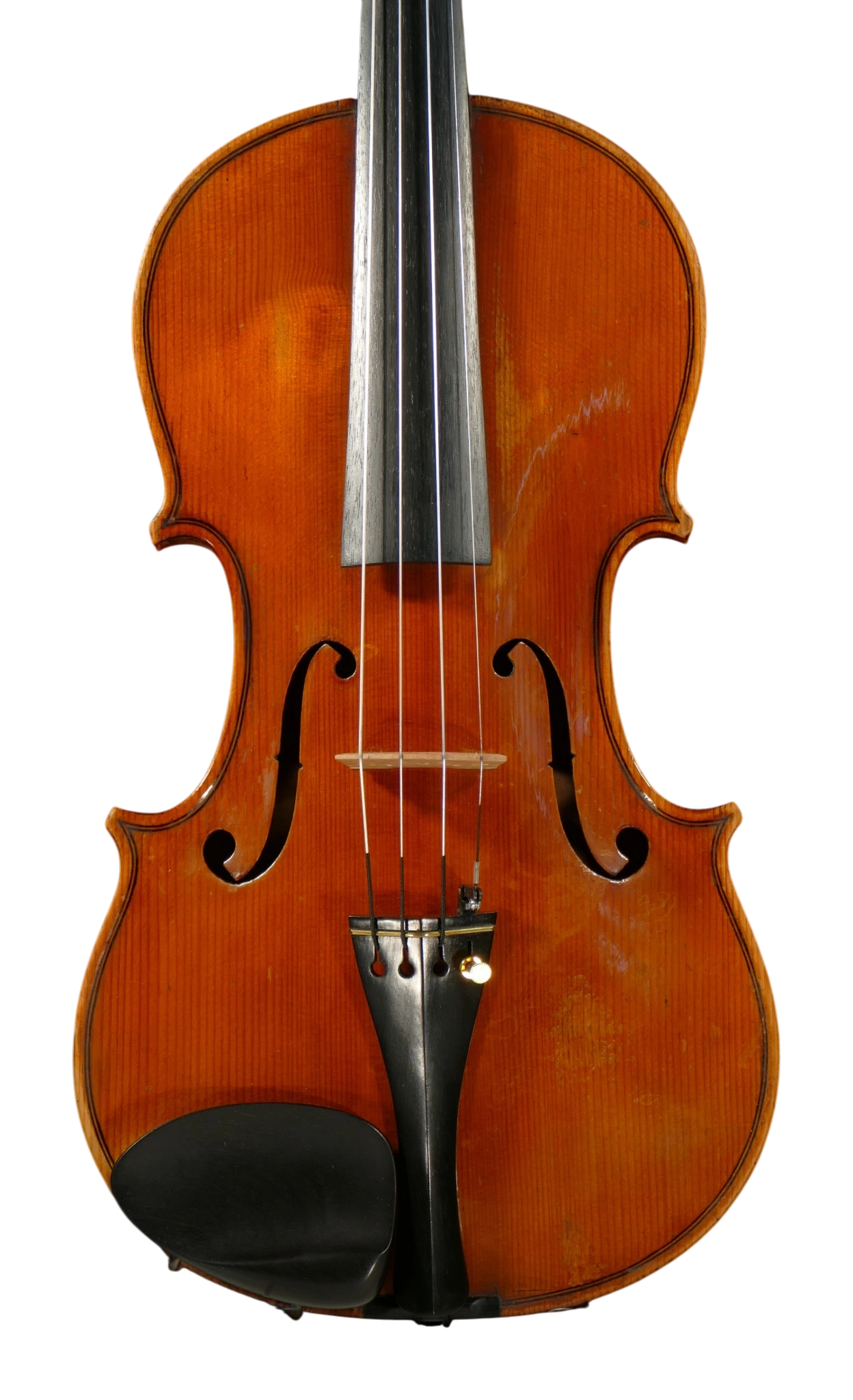
This violin by Carlo Carletti, made around 1920, is an especially beautiful and distinguished example of his work. It is immediately apparent that this is not one of the more simply made instruments associated with his circle, but a meticulously executed violin of distinctly Italian character and a quality that bears comparison with good work by Ettore Soffritti.
Carlo Carletti was born in 1873 in Pieve di Cento, near Bologna, and is one of the notable figures in the history of early 20th-century Italian violin making. He initially dealt in antiques and restored furniture before devoting himself increasingly to violin making. He maintained close contact with important makers of his time: he learned within Raffaele Fiorini’s circle, was influenced by Augusto Pollastri and Ettore Soffritti, and later also worked for Leandro Bisiach’s renowned Milan workshop, supplying instruments in the white. Together with Luigi Mozzani and Anselmo Gotti, he was also involved in establishing instrument production in Cento. His own personally made and labelled instruments are comparatively rare.
It is precisely this confluence of several important Italian schools that makes Carletti so interesting today. His work occupies a position between the Bolognese and Ferrarese traditions and often follows a Stradivari-derived model, combined with a highly individual style. His best instruments, however, possess a refinement and elegance distinctly surpassing the more workshop-oriented output of his wider circle. Both contemporary and present-day specialist sources associate his work particularly with Soffritti, Bisiach and Fiorini; Carletti is also known to have favoured native varieties of maple and characterful orange to reddish-brown varnishes.
The present instrument displays precisely these qualities. The two-piece maple back has broad, gently flowing flame, while the ribs exhibit far stronger and highly attractive figuring. The table is of well-selected spruce with evenly spaced annual rings. Particularly successful are the long, elegant f-holes and the finely worked edges and corners. The scroll is robust yet harmoniously carved, with the distinctive, deeply modelled form characteristic of Carletti’s better work.
The warm golden-orange to subtly reddish varnish is also particularly beautiful, lending the instrument considerable depth and bringing out the structure of the wood to excellent effect. The varnish appears neither sterile nor excessively perfect, but has the natural vitality sought in fine Italian instruments of this period. The violin is also in an exceptionally well-preserved, crack-free condition, which is all the more remarkable in an instrument around one hundred years old.
Tonally, the violin confirms the strong impression made by its appearance. The sound is rounded, powerful and substantial without becoming hard or aggressive. It has excellent fundamental body, together with sufficient brilliance and overtones to project convincingly even in a larger space. Particularly pleasing is its combination of warmth and carrying power: the sound remains focused and refined even under greater bow pressure and responds very well to dynamic shaping.
For us, this is one of those instruments in which maker, condition, craftsmanship and sound come together exceptionally well. Fine, independently made works by Carlo Carletti are distinctly rarer than instruments merely originating from his workshop circle. In our assessment, this example ranks among his particularly beautiful works and, both in execution and overall appearance, attains a level approaching that of Ettore Soffritti’s better instruments.
Carlo Carletti, Pieve di Cento, c. 1920 – an exceptionally fine Italian instrument, preserved without cracks, with abundant character and quality, and a powerful, rounded and richly coloured sound