
About this instrument
Arnold Otto Schmidt – Cello, Mannheim
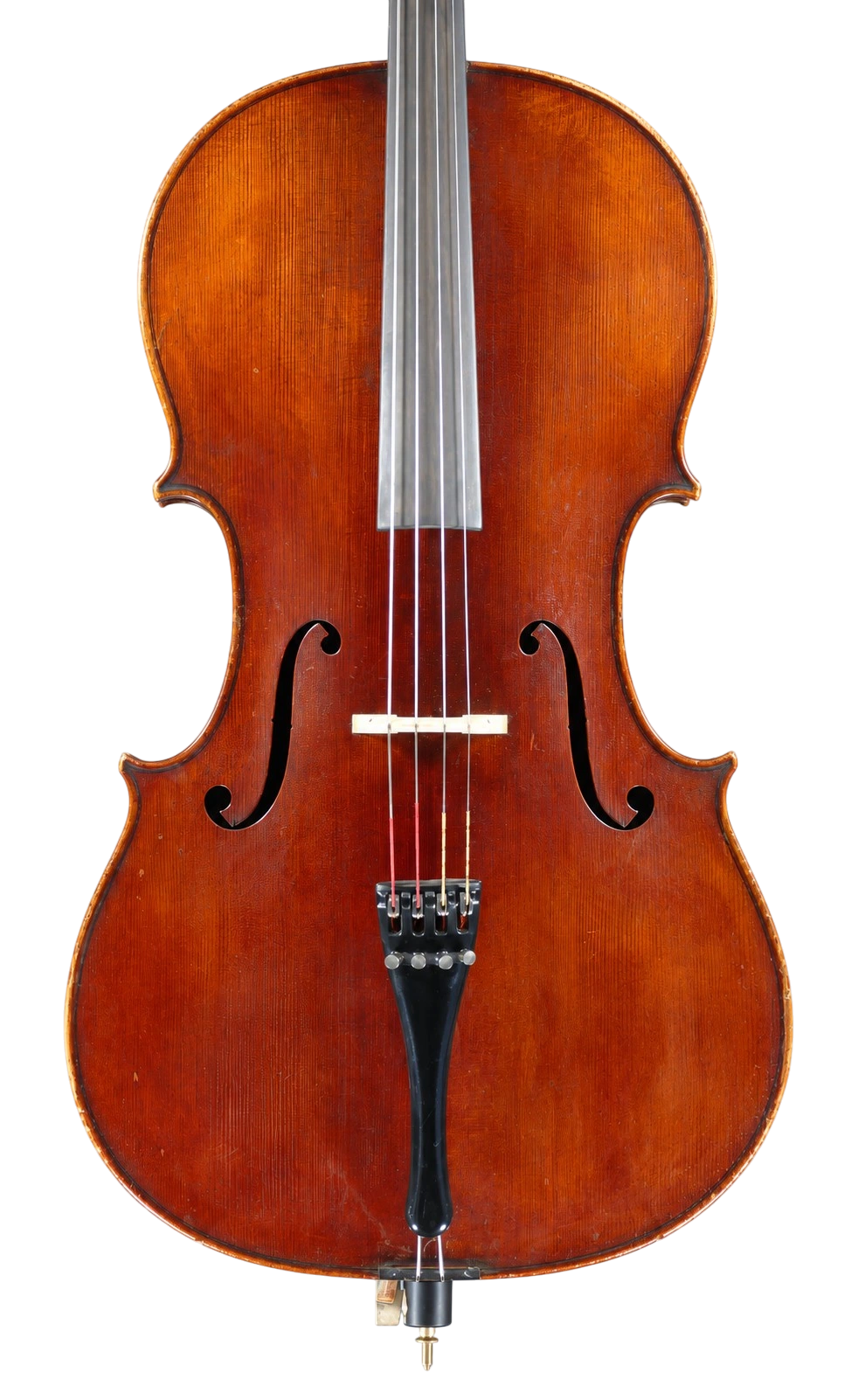
Rare Ruggeri copy · poplar back · from the Schmidt family estate · body length 74.5 cm
An exceptionally rare cello by Arnold Otto Schmidt, made as a finely conceived copy of a Ruggeri. The provenance of this instrument is itself noteworthy: we were able to acquire the cello directly from the Schmidt family estate. Cellos by this maker are exceedingly rare today. Even the major publicly accessible auction archives document only a few instruments by Arnold Otto Schmidt—predominantly violins—making a surviving cello of this quality all the more interesting.
Arnold Otto Schmidt was born in Markneukirchen in 1897 and came from a family of violin makers. He was the son and pupil of the violin maker Anton Otto Schmidt, subsequently worked for E. W. Geipel in Mannheim, and later established his own workshop there. His activity in Mannheim is documented from as early as 1917. A historic Mannheim advertisement from 1933 expressly refers to him as “Master Violin Maker Arnold Schmidt” and describes his workshop as a “Workshop for Fine Violin Making”.
The cello offered here clearly demonstrates that, in his finer work, Schmidt engaged closely with historic Italian models. The poplar back is particularly appealing, its broad, lively and irregular figure lending the instrument an entirely different character from that of a conventionally highly flamed maple back. The wood has a restrained yet highly individual appearance. The ribs, by contrast, display attractive flame and, together with the handsomely figured neck, form an effective contrast with the poplar back.
The table has an exceptionally fine, even spruce grain. The warm reddish-brown to amber varnish is very harmoniously preserved throughout the instrument and possesses a natural depth that is particularly striking on the back and ribs. The elegantly cut f-holes, pronounced corners and slender, beautifully balanced outline emphasise the character of the historic Ruggeri model. The scroll is also boldly and individually carved and bears the instrument’s warm, dark reddish-brown varnish.
A distinctive feature is the body length of just 74.5 cm. The cello thus has a comparatively compact and exceptionally elegant body, modelled on the historic original. Crucially, however, Schmidt retained standard playing dimensions. For the player, the instrument therefore does not feel like a problematically reduced-size cello. On the contrary, its somewhat more compact body makes it exceptionally pleasant and comfortable to handle, without requiring any adjustment to a different neck length, string length or playing dimensions.
It is in its sound, in particular, that this cello proves so surprising. Despite its compact body, there is no perceptible tonal limitation. On the contrary, its sound has a depth, warmth and maturity immediately suggestive of a considerably older instrument. It sounds remarkably unlike a 20th-century German cello; rather, playing it gives the impression of a cello some 200 years old: dark and warm at its core, yet open, colourful and endowed with the slightly dry, mature complexity associated with fine old Italian instruments. The poplar back is likely to contribute, at least in part, to this cello’s highly individual character.
The response is pleasingly immediate, yet never one-dimensional. Particularly convincing is the combination of warmth, projection and a broad palette of tonal colours. Even under greater bow pressure, the sound remains cultivated and opens up rather than becoming hard. The instrument is therefore equally well suited to a player seeking a large, characterful solo sound and to chamber or orchestral playing.
The cello is also in exceptionally fine, well-preserved condition. In conjunction with its rare construction, poplar back, Ruggeri-inspired conception and direct provenance from the family estate, it is, in our view, one of the most interesting surviving instruments by this now little-known Mannheim master.