
About this instrument
Nicolas Vuillaume, Mirecourt, circa 1850
This characterful French violin was made by Nicolas Vuillaume in Mirecourt around 1850 and comes from a private collection. The instrument is offered by us on behalf of its owner.
Nicolas Vuillaume came from the important Vuillaume family of violin makers in Mirecourt and was a younger brother of the celebrated Jean-Baptiste Vuillaume. From 1832 to 1842, he worked in his brother’s Paris workshop before returning to Mirecourt, where he continued his own production. His work is thus directly connected with one of the foremost French violin-making traditions of the 19th century.
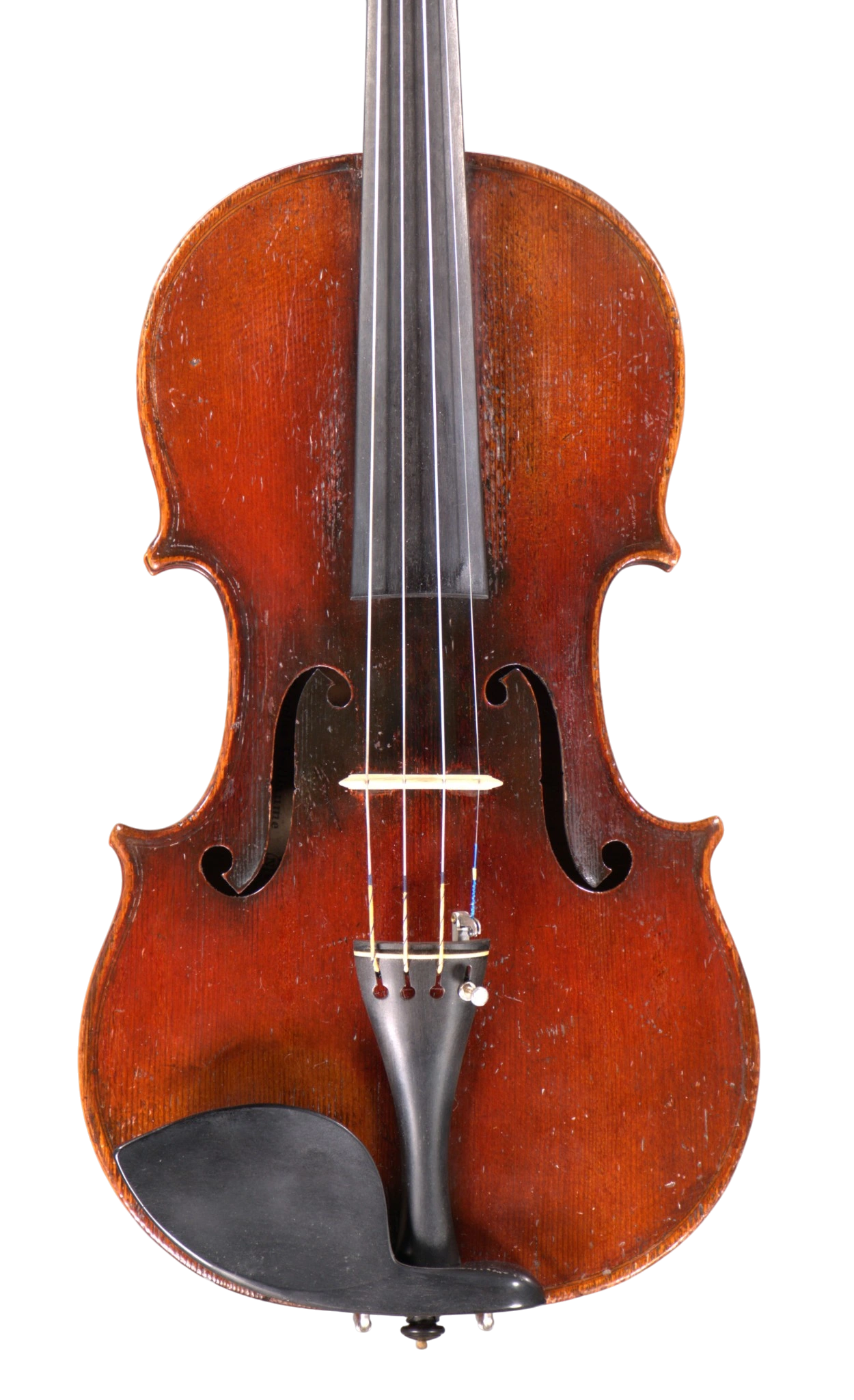
The violin displays a highly appealing, classically French character. Particularly attractive is the one-piece maple back, with fine to medium flame, the figure continuing into the ribs. The table is of spruce with regular grain. A warm, deep reddish-brown to orange-brown varnish lies over a golden ground and displays an attractive, naturally developed patina across the entire surface. Signs of use and fine craquelure lend the instrument considerable character without detracting from its elegant overall appearance.
The modelling is likewise highly typical of French work from this period: clearly defined outlines, cleanly worked edges and corners, and distinctive, relatively upright f-holes. The scroll is boldly carved and displays an attractive, subtly individual hand. Overall, the violin has a remarkably cohesive and authentic appearance, successfully balancing precise workmanship with the natural charm of an instrument some 175 years old.
Tonally, it is distinguished by a dark, warm and richly coloured fundamental voice. The E string is especially appealing: despite the instrument’s generally darker tonal character, it remains clear and radiant without becoming sharp. The sound is rounded, chocolatey and full, while also possessing a fine, lively “sizzle” that lends the tone additional presence and tension.
The violin responds very directly and quickly to the bow and offers an exceptionally easy playing experience. It speaks immediately with very little bow weight, is readily shaped and remains open and flexible even under stronger bowing. This makes it particularly suitable for players seeking a warm, characterful sound without sacrificing clarity, responsiveness or brilliance.
A most interesting French instrument from the mid-19th century, distinguished both by its origins in the Vuillaume family and by its individual tonal personality.