
About this instrument
François Peccatte – Violin Bow, Mirecourt, c. 1845
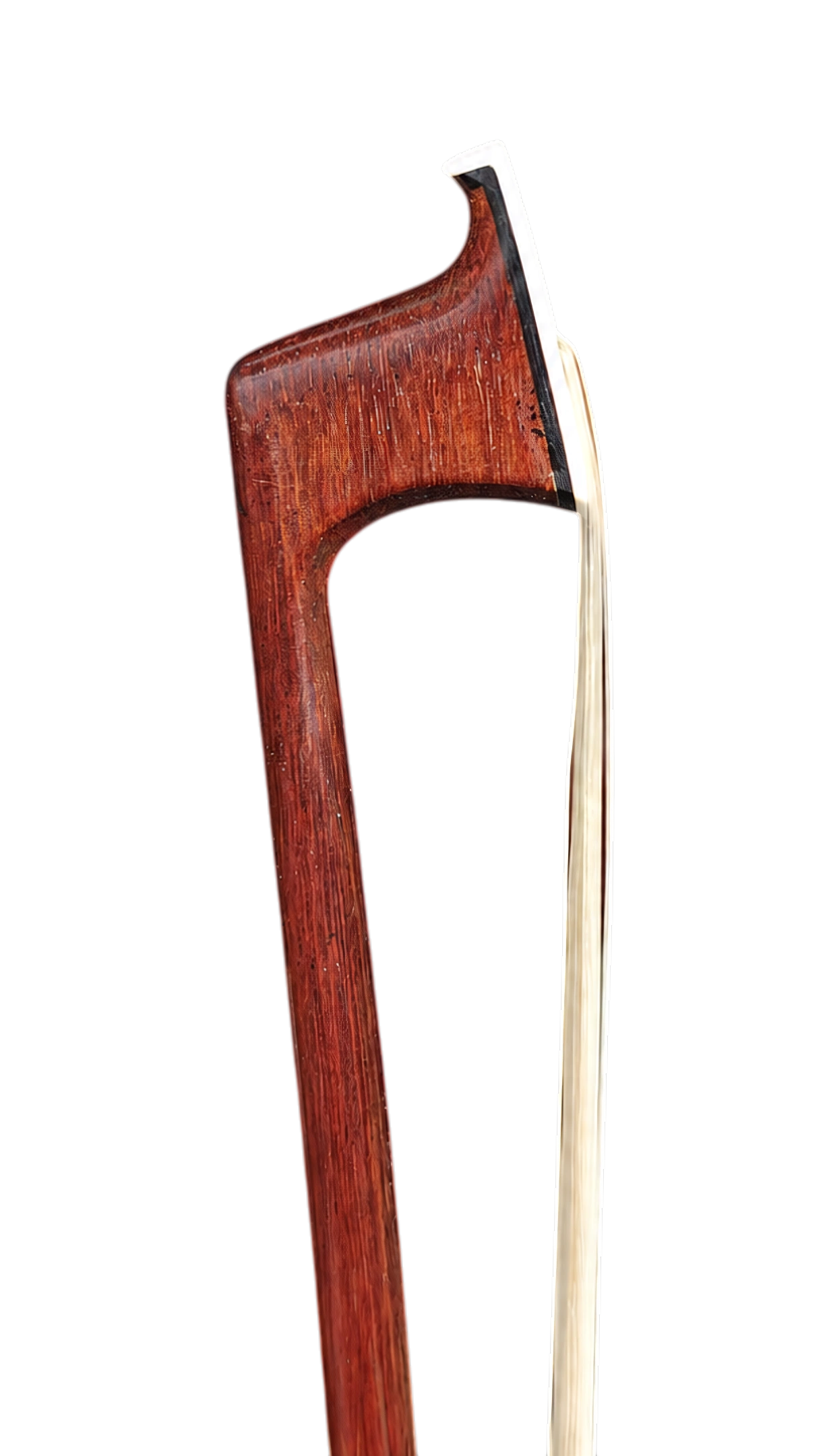
This violin bow by François Peccatte, made in Mirecourt around 1845, is distinguished by its expressive workmanship and particularly fine pernambuco stick. The round stick displays lively figuring and a warm colour; in his certificate, Pierre Guillaume expressly notes the beauty and rarity of the wood used. The strong, boldly cut head bears the maker’s characteristic hand. A classic ebony frog with plain mother-of-pearl eyes and nickel-silver mounts complements the bow’s distinctive appearance.
François Peccatte (1821–1855) was the younger brother of Dominique Peccatte and an important exponent of the 19th-century French bow-making tradition. After training in the Mirecourt area, he worked for a time with his brother in Paris before returning to Mirecourt in 1842. Dominique’s influence is clearly apparent in his work, particularly in the powerfully conceived heads and assured modelling.
The particular quality of this bow, however, reveals itself in playing. It draws from the instrument the varied, finely nuanced tonal colours one hopes for from a French bow bearing this name. The sound gains in expression, acquires a rich spectrum of overtones and can be shaped with remarkable freedom. On a fine instrument in particular, this Peccatte can open up additional tonal possibilities and bring out qualities that remain less apparent with another bow. This also makes it a particularly appealing choice for solo playing: a bow that does not merely support the instrument, but allows its tonal personality to emerge more fully.
A notable feature is the small original wooden insert in the central section of the stick. This is not a later repair, but an insertion made during the bow’s construction. It may have served to compensate for a natural irregularity in the wood, such as a knot. In the certificate, Pierre Guillaume expressly describes it as a “pièce originale sans conséquence”, meaning an original insertion without adverse consequences. According to his supplementary statement, it has no detrimental effect on either the value or the playing qualities of the bow.
At 61.2 grams, the bow has a very good, practical playing weight. Those who prefer a somewhat lighter bow could have the weight reduced slightly by fitting a lighter winding, thereby adapting it to their personal preference.
The bow is offered with a certificate of authenticity issued by Pierre Guillaume, Brussels, dated 14 March 2024. In it, Guillaume confirms the bow in all essential parts as the authentic work of François Peccatte.