
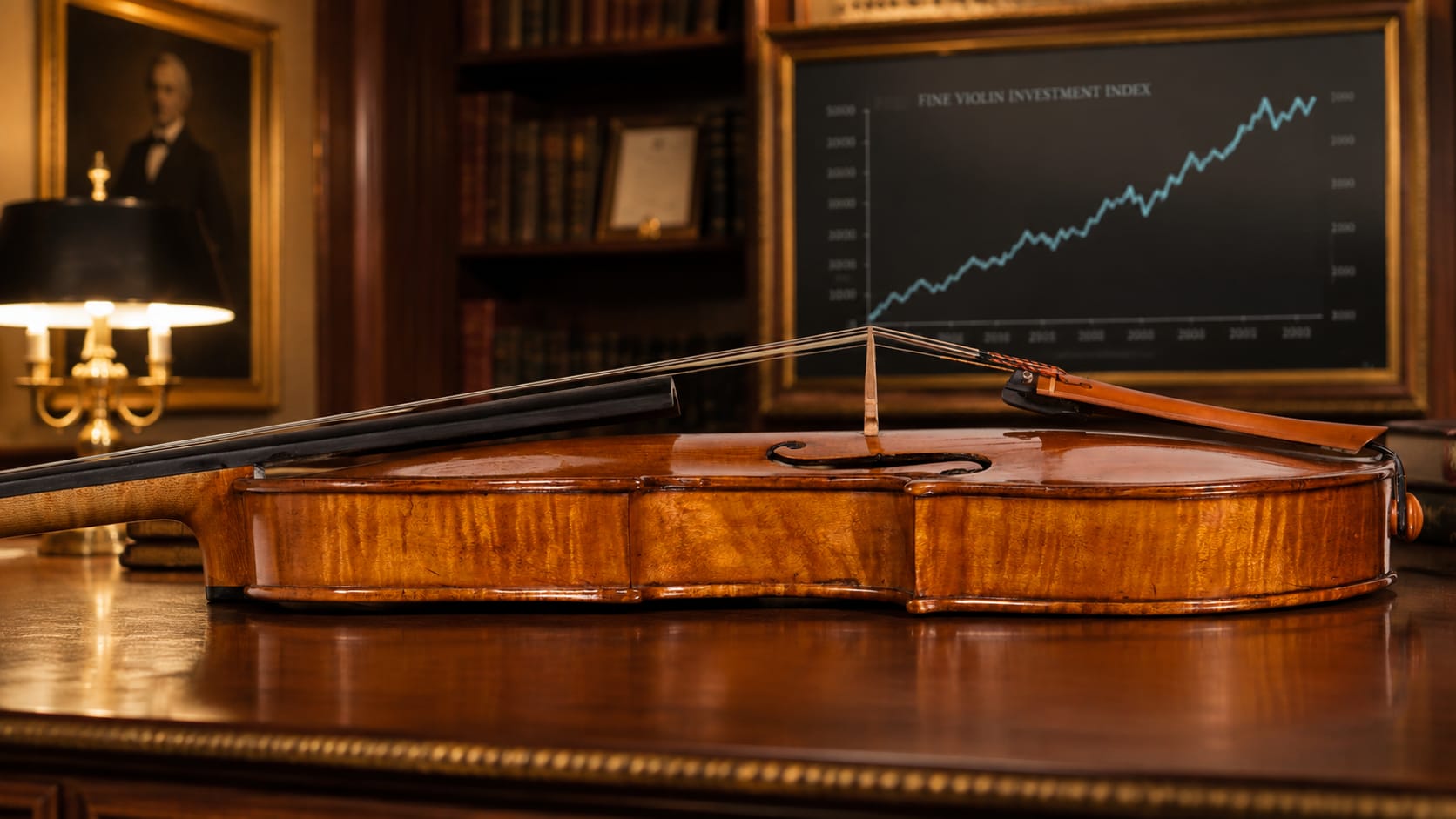
Historical stringed instruments are often described simultaneously as musical instruments, cultural assets, collectors’ items and tangible assets. These four attributes may coexist in a single instrument, but economically they are not the same. An outstanding playing instrument need not be a particularly liquid collectors’ item. A museum-quality instrument may command a high market value even though it is rarely played. And a spectacular auction record says nothing about the return a typical buyer might have achieved after all costs.
A dispassionate examination of the market must therefore distinguish between three levels: long-term price indices, actual observed repeat sales of the same instrument and individual top results. This article analyses the most important peer-reviewed study of returns in the violin market, together with documented public auction results. Asking prices, unconfirmed private sales and promotional claims about value have deliberately been excluded.
Quantitative research relates almost exclusively to violins. The published data for violas, cellos and bows are considerably thinner. Accordingly, where historical stringed instruments are discussed below as a market segment, the robust returns indices are derived predominantly from the violin market.
An Instrument Is Not a Standardised Asset Class
Shares of the same class are interchangeable. Historical instruments are not. Even two violins by the same maker from the same year may differ substantially in model, condition, originality, sound, provenance and quality. Later interventions add further variables: neck modernisation, edge doubling, soundpost cracks, arching corrections, retouching or replaced parts may materially alter the economic assessment.
The market itself is also divided. Public auctions provide visible results, but represent only the portion of the supply that is actually consigned and sold. Important instruments frequently change hands privately through specialist dealers or intermediaries; prices and terms are often not disclosed. A purely auction-based index is therefore more transparent, but not necessarily representative of the market as a whole.
The central question is thus not: “Do old violins increase in value?” A more precise formulation would be: For which group of instruments, over what period, in which currency, through which sales channel, and before or after which costs was a price change measured?
Two Methods—Two Different Findings
The most comprehensive academic investigation was conducted by the economists Kathryn Graddy and Philip E. Margolis. Their study, “Fiddling with Value: Violins as an Investment?”, published in Economic Inquiry in 2011, uses two datasets and two methods [1].
The repeat-sales approach observes the same instrument at two different points in time. Many immutable characteristics of the particular instrument thereby remain constant automatically. Its weakness lies in selection: only instruments with at least two documented sales enter the dataset. Restorations, new certificates or revised attributions may also have occurred between the two dates.
The hedonic approach, by contrast, uses numerous individual auction results and statistically controls for identifiable characteristics such as maker and age. It permits a denser time series, but depends on whether the model adequately captures the relevant differences in quality. Condition, individual merit, provenance and sound can be standardised only to a limited extent in historical catalogue data.
The repeat-sales dataset contains 259 instruments and 337 sale pairs from the mid-19th century to 2009. The average holding period was 32 years, while the shortest interval included was five years. Of the observations, 168 concerned Stradivari and 33 Guarneri “del Gesù”. This composition alone makes clear that the findings describe a high-quality, highly selective market segment—not “the old violin” in general.
The second dataset comprises 2,669 auction observations from 1980 to 2009 and 129 makers. Of these observations, 1,059 related to old Italian, 1,004 to modern Italian and 394 to French instruments. From these, the authors calculated quality-adjusted price indices.
What the Historical Return Figures Actually Show
For repeat sales between 1850 and 2008, Graddy and Margolis calculate an average real annual return of approximately 3.5 percent. Here, “real” means after general inflation, but not after the full deduction of all individual acquisition, sale and holding costs. For the broad portfolio of individual auction sales since 1980, the real annual return is approximately 3.3 percent [1].
Within the long-term repeat-sales dataset, the sales channels differ: the study reports real annual returns of approximately 2.86 percent for auction sales and 4.32 percent for dealer transactions. These figures must not be interpreted as a dependable “dealer premium”. The instruments, quality of documentation and selection of pieces sold differ between the groups. The authors therefore refrain from deriving a supposedly more accurate market return from an arbitrary mixture of the two channels.
Comparison of real annual returns, 1980–2008
The figures come from the same study and the same comparison period. They are historical index figures, not forecasts.
Over the common comparison period from 1980 to 2008, the real returns of the instrument indices are lower than the returns reported in the study for the S&P 500 and US Treasury bonds. At 5.40 percent, the modern Italian group comes closer to these benchmark series; the overall index of fine violins reaches 3.33 percent, the old Italian group 2.34 percent and the French group 2.96 percent.
This is not a ranking for purchases made today. These are historical averages from a particular dataset. The comparison assets are also liquid, continuously priced and readily diversified. A single instrument is indivisible, requires expertise and cannot be sold without an expenditure of time and money.
More Recent Research: Volatility Is Greater Than a Smooth Long-Term Curve Suggests
A study by Elroy Dimson, Kuntara Pukthuanthong and Blair Vorsatz, published in the Financial Analysts Journal in 2026, uses an extended violin time series: 320 individual violins, 1,328 repeat sales and a raw period spanning 1876 to 2012 [13]. For the standardised comparison from 1901 to 2007, the nominal GBP series shows an arithmetic average return of 5.38 percent, a geometric annual rate of 2.60 percent and a standard deviation of 23.81 percent.
The average is not the same as long-term growth
A recent analysis of the extended violin time series reveals how widely individual annual figures fluctuate and how substantially volatility depresses the long-term growth rate.
The difference between the arithmetic and geometric means is not a contradiction. The arithmetic mean describes the average annual figure; the geometric rate indicates the constant rate at which the capital would notionally have grown over the full period. Substantial fluctuations depress the geometric rate. The recent study thus reveals a risk that may easily be underestimated in smoothed long-term indices.
This study does not independently confirm the earlier returns figures. It uses an expanded version of the same repeat-sales data assembled by Graddy and Margolis. The authors also highlight typical biases: successfully resold assets are more likely to enter the index, failed auctions are absent, prices arise at irregular intervals and transaction costs are not deducted [13]. A further peer-reviewed study by Chan, Gong and Yip finds fewer sales during recessions and higher average returns for sales outside recessionary periods [14]. This points to liquidity and timing effects, not to a reliably tradable strategy based on the economic cycle.
Price Performance by School—Not by Famous Name
The annual auction indices show a long-term upward trend, but by no means a steady one. Interim years with declines can be seen in all three groups. From 1980 to 2009, the nominal index for the old Italian school rose from 1 to 6.50, the French school to 7.95 and the modern Italian school to 12.01 [1].
Hedonic auction indices by school, 1980–2009
Nominal, quality-adjusted indices; 1980 = 1. A value of 6.5 does not mean that every instrument increased sixfold in price.
The strongest growth achieved by the modern Italian group is an important finding, but does not prove that every 19th- or 20th-century instrument appreciated accordingly. The group combines different makers, periods, qualities and price levels. In the material studied, Giovanni Francesco Pressenda and Giuseppe Rocca are among the particularly highly valued names. The study does not, however, provide a robust individual returns index for Pressenda, Rocca, Stradivari or Guarneri “del Gesù”.
The data become particularly sparse for the most famous makers. Rare masterpieces appear on the public market only sporadically; a few exceptional sales could shift an annual index considerably. Graddy and Margolis therefore group Stradivari and Guarneri with other old Italian makers rather than constructing a spuriously precise curve for an individual master from too few observations.
What Individual Maker Cases Show—and What They Do Not
For a more focused assessment, documented repeat sales of the same instrument are more informative than comparisons between unrelated record lots. Four publicly verifiable examples involving Jean-Baptiste Vuillaume, Giovanni Francesco Pressenda, Ansaldo Poggi and Giovanni Battista Guadagnini nevertheless demonstrate how widely even such nominal gross rates can diverge.
Four identical instruments resold publicly
Unlike a comparison of auction records, each pair of price observations relates to the same identified instrument. The differences nevertheless remain substantial.
Jean-Baptiste Vuillaume
“St Paul,” 1870 violin · No. 2809
Giovanni Francesco Pressenda
1833 viola · Cozio 51181
Ansaldo Poggi
1931 violin · Cozio 52949
Giovanni Battista Guadagnini
“Hamma,” 1765 violin · Cozio 42584
The Pressenda viola rose nominally from £1,400 to £79,250 over almost 42 years, producing a calculated annual rate of 10.11 percent before inflation and costs [10]. The “Hamma” Guadagnini achieved a nominal annual rate of 13.11 percent between 1966 and 1981 [12]. By contrast, the price of the Poggi violin rose only from £19,550 to £20,700 between 1996 and 1998, equivalent to 2.58 percent annually before costs [11]. With such a short holding period, transaction costs could easily have consumed the entire gain.
These examples are deliberately not a ranking of makers. Each line describes a different instrument, a different period and a different market situation. Their value lies precisely in their dispersion: a famous name does not generate a uniform return, and a high long-term nominal multiple may be misleading without adjustments for inflation and costs.
Spectacular Price Increases: Informative Yet Hazardous
One particularly frequently cited example is Antonio Stradivari’s “Lady Blunt”. This exceptionally well-preserved instrument realised £84,500 at Sotheby’s in 1971 and £9.808 million at Tarisio in 2011 [3][4]. These two prices produce a nominal multiple of 116.1 and, calculated using the exact sale dates, annual price growth of 12.60 percent.
“Lady Blunt”: a spectacular price observation, but not a fund return
Two publicly documented sale prices for the same instrument illustrate the scale—and at the same time the limitations—of such a calculation.
This calculation illustrates the enormous appreciation of a singular masterpiece. It is not, however, an investor’s realised return. The violin changed hands privately several times between the two auctions. The intervening purchase prices are not public, and according to the documented provenance no buyer held it continuously from 1971 to 2011. The 2011 sale was also a highly publicised international charity auction in aid of the victims of the earthquake and tsunami in Japan. Its exceptional state of preservation was another material factor.
Other record prices must likewise be read as observations at the uppermost edge of the market. The “da Vinci, ex-Seidel” Stradivari realised $15.34 million at Tarisio in 2022 [5], while the “Baltic” Guarneri “del Gesù” realised $9.44 million in 2023 [2]. In 2025, the “Joachim-Ma” Stradivari sold at Sotheby’s for $11.25 million—well below the published presale estimate of $12 million to $18 million [8]. Even at the absolute pinnacle of the market, results therefore do not automatically progress from one record to the next.
Selected public sales by maker
The selection illustrates the range within the upper market segment. Individual records are neither average prices nor time series.
Antonio Stradivari
“Lady Blunt,” 1721 violin
£9.808 millionExceptionally well-preserved condition; charity auction in aid of disaster relief in Japan.Giuseppe Guarneri „del Gesù“
“Baltic,” 1731 violin
$9.44 millionPublished by Tarisio as the auction record for the maker at the time.Giovanni Battista Guadagnini
Violin
$2.107 millionListed in the auction-record archive as the highest price achieved there for a violin by the maker.Nicolò Amati
“Grand Pattern,” 1648 violin
$620,000Rare example retaining its original neck; published auction record at the time of sale.Giovanni Francesco Pressenda
Violin
$383,750Top result at a New York auction; not an average value for Pressenda instruments.Samuel Zygmuntowicz
Violin
$180,000An example showing that contemporary makers can also achieve high individual results.The selected results show the prices publicly achieved by outstanding examples from particular makers. They do not show the average market value associated with a name. A single auction record combines maker, specific work, period, condition, provenance, certificates, timing of sale, currency and competition among bidders in one observation.
Factors Underpinning an Instrument’s Value
Attribution and Authenticity
A robust identification is the essential starting point. A label is not proof of authenticity. Market value arises from the congruence of style, construction, materials, age, documentation and recognised expertise. A revised attribution can shift value substantially—in either direction. Certificates are therefore not merely accessories; what matters is who issued them, the examination on which they are based and whether the contemporary expert community continues to support the attribution.
Quality, Model and Period of Work
A maker’s name does not determine a single uniform price. Within an œuvre, particular periods, models and especially convincing works are valued differently. Stradivari instruments from the so-called Golden Period have a different market profile from some early or late works. With Pressenda, Rocca, Guadagnini and Vuillaume too, the specific instrument—not the signature alone—is decisive.
Condition and Originality
A history of repairs is normal for historical instruments. Economically, the nature, extent and quality of the interventions are decisive. Original varnish, preserved edges, an unaltered scroll and coherent original material can justify a substantial premium. Soundpost cracks, back cracks, extensive doubling, altered arching or substantial replacements can limit both the pool of buyers and the price. Good restoration can safeguard playability and stability, but cannot restore original material that has been lost.
Provenance and Documentation
An unbroken, verifiable provenance reduces uncertainty. Important former owners or a documented concert history may generate additional demand, particularly where they are closely associated with the instrument. The effect cannot, however, be measured across the board. Famous names are no substitute for authenticity or condition; at best, they enhance the significance of an already compelling instrument.
Musical Utility
Unlike many collectors’ items, stringed instruments can provide continuing utility through use. For a musician, this lies in sound, response, projection and artistic identity; for a foundation, it may lie in loan programmes and public impact. This utility is real, but cannot readily be converted into a financial return. Intensive use may at the same time increase the risks of wear and damage.
Dimson, Pukthuanthong and Vorsatz call this non-financial utility an “emotional yield”. For their violin series, the point estimate is 2.26 percent per year, with an adjusted standard error of 2.65 percent [13]. The figure is therefore not statistically distinguishable from zero with precision. Above all, it is neither a cash flow nor a return that may simply be added mechanically to price appreciation.
Rarity and Market Breadth
Scarcity alone is not enough. A rare instrument is liquid only if enough informed buyers are seeking that particular school, maker and price bracket. The broadest international demand is concentrated on a limited number of recognised names. For lesser-known makers, outstanding quality and rarity may encounter a very narrow pool of buyers.
From Price Appreciation to Net Return: The Often-Overlooked Costs
The auction prices used in the study include the buyer’s premium, but known seller’s commissions could not be fully incorporated historically. Further expenses include insurance, secure storage, regular inspection, adjustment, transport, certification and, where necessary, restoration. Taxes, import duties, permits and exchange rates may become relevant in cross-border transactions.
Graddy and Margolis demonstrate the effect of transaction costs through scenarios: costs of 15 percent on a sale every 30 years reduce the annualised return by approximately 0.5 percentage points. Costs of 30 percent on a sale every 20 years reduce it by approximately 1.5 percentage points [1]. Even small annual deductions alter the final result substantially over long periods.
Not every expense is economically unambiguous. A necessary restoration preserves the instrument’s substance and saleability, but may at the same time document previous damage. A high-quality expert opinion can reduce uncertainty and broaden the market, but does not guarantee a later price. The opportunity cost of the capital tied up must also be included in a complete assessment, even though it appears on no instrument-related invoice.
The Principal Risks
Illiquidity and Timing Risk
The right buyer must be found for an important instrument. A rapid sale may require a price discount; a discreet private sale may take months or longer. Public auctions create competition, but carry the risk that the instrument will remain unsold or produce a publicly visible result below expectations.
Information and Attribution Risk
Buyers depend on specialist expertise. New research, additional comparison instruments or doubts concerning a certificate may alter an attribution. With a high-value individual object, this risk is concentrated and cannot be diversified as readily as it can in a securities portfolio.
Condition and Damage Risk
Wood responds to climate and mechanical stress. Open seams, cracks, deformation, accidents, fire or theft may cause high costs and losses in value. Insurance transfers part of the financial risk, but prevents neither the loss of historical material nor disputes about actual market value.
Valuation and Comparability Risk
There is no continuously quoted market price between two sales. Insurance value, dealer asking price, auction estimate, hammer price and the net proceeds achievable on an immediate resale are different figures. Treating them as equivalent can easily lead to an overstatement of the economic position.
Concentration, Currency and Regulation
A single instrument ties up a substantial sum in one object. International markets also entail currency risks. Depending on age, materials, origin and destination country, export regulations, cultural-property protection or endangered-species rules may complicate transport and sale. These issues must be reviewed on a current basis for every instrument and every transaction.
Diversification: An Interesting Observation, but Weak Evidence
The study finds a slightly negative correlation between the historical violin index and equities and bonds. At first sight, this suggests a diversification effect. Statistically, however, the finding is weak: the estimated sensitivity to the equity market was not significant, the time series are sparse and the asset class is small, heterogeneous and illiquid. Traditional capital-market models also assume continuous pricing and relatively low transaction frictions—conditions that historical instruments distinctly fail to meet.
Moreover, instruments pay no recurring interest or dividends. Their total economic utility may consist of price appreciation and musical use. Someone who plays an instrument professionally every day values that use differently from a collector, a foundation or a purely financially motivated buyer. A serious analysis should acknowledge the cultural and musical utility, but not retrospectively present it as a guaranteed return.
Conclusion: A Selective Tangible-Asset Market, Not a Promise of Returns
The historical data show that fine violins have achieved real appreciation over long periods. Depending on dataset and period, the most important academic study finds average real annual returns of approximately 3.3 to 3.5 percent before all individual costs are fully accounted for. Individual groups—particularly modern Italian instruments during the period from 1980 to 2008—performed more strongly. Exceptional instruments by Stradivari, Guarneri “del Gesù” and Guadagnini achieved spectacular record prices.
The limitations are equally clear. The data for the broad academic index end in 2009. Private sales remain partly invisible. Record auctions are not averages, and the small number of important instruments prevents robust returns curves from being constructed for many individual makers. Condition, attribution, provenance, costs and sales channel may affect the outcome more strongly than the general movement of a school.
Historical stringed instruments may therefore be soberly described as heterogeneous, illiquid tangible assets with the potential for additional musical utility. Whether a specific instrument is economically compelling can be answered only on an instrument-by-instrument basis. Neither past indices nor famous records imply assured appreciation or constitute a recommendation to buy.
Sources and date of data
Verifiable sources
- [1]Kathryn Graddy & Philip E. Margolis (2011)Fiddling with Value: Violins as an Investment? · Economic Inquiry 49(4), 1083–1097 · DOI 10.1111/j.1465-7295.2010.00269.x
- [2]
- [3]Tarisio / Cozio ArchiveSale and provenance history of the “Lady Blunt” Stradivari
- [4]
- [5]
- [6]
- [7]
- [8]Sotheby’s“Joachim-Ma” Stradivari, 2025 result
- [9]Ingles & Hayday / Tarisio Cozio ArchiveJ.-B. Vuillaume “St Paul” · identity, number 2809, provenance and 1988 saleVuillaume price archive · 2012 result
- [10]
- [11]
- [12]
- [13]Elroy Dimson, Kuntara Pukthuanthong & Blair Vorsatz (2026)Emotional Yields of Collectibles · Financial Analysts Journal 82(2) · peer-reviewed manuscript version and DOI 10.1080/0015198X.2026.2639952
- [14]M. W. Luke Chan, Dan Sabrina Gong & Terry A. Yip (2020)Return on violin and macroeconomic fluctuation · Journal of Cultural Economics 44, 339–346
Editorial data current as at 19 August 2026. The peer-reviewed study [1] is authoritative for the long-term returns and index statements by school; its auction time series ends in 2009. The study published in 2026 [13] adds a longer repeat-sales series and a current risk perspective, but is based on the same underlying dataset. Later record sales update individual public observations but do not replace a broad market index.