
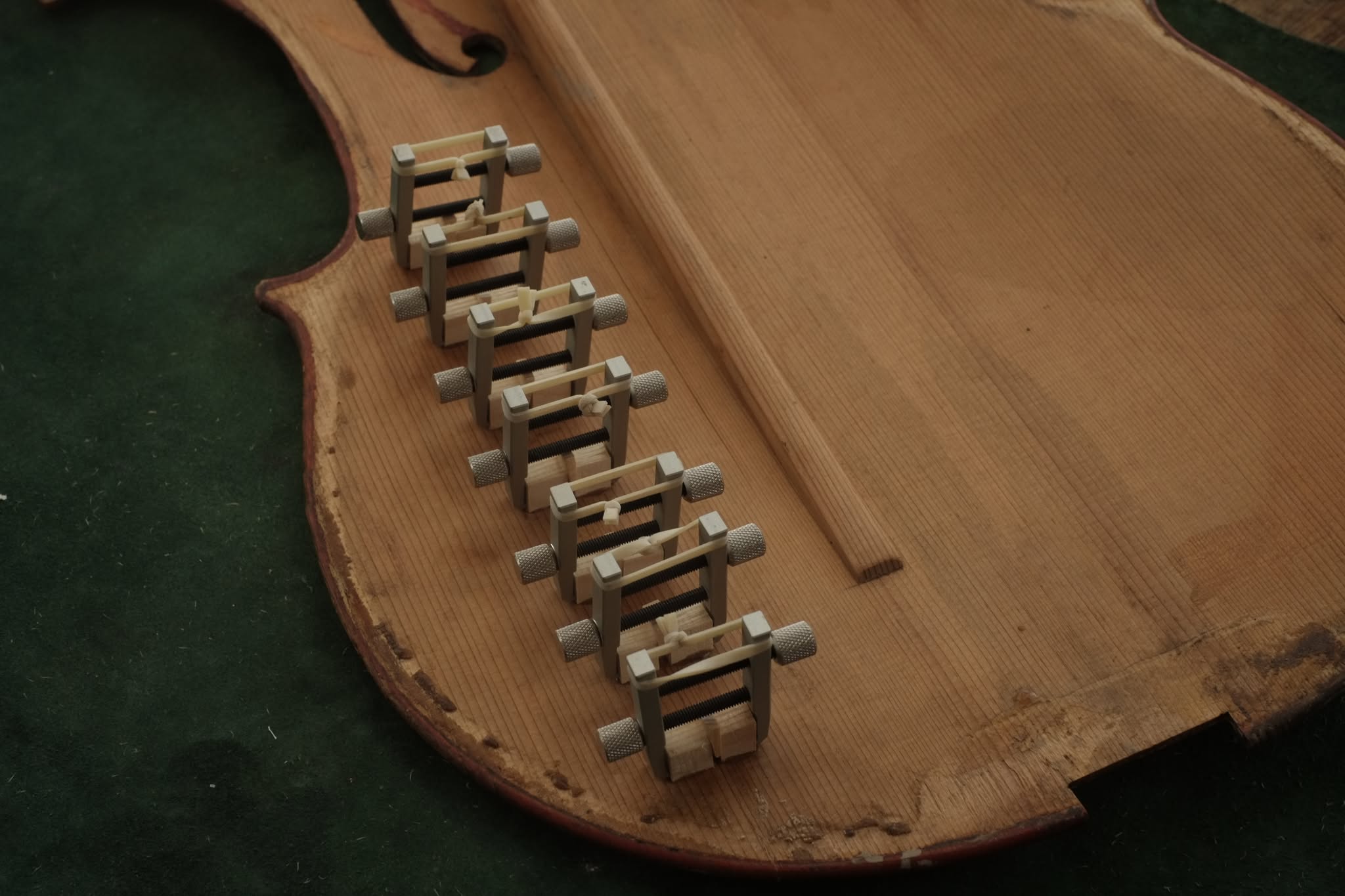
When restoring an old string instrument, preserving its original material is my first priority. Once lost, its wood, varnish and the distinctive details of its maker’s craftsmanship cannot be authentically replaced. That is why, before any intervention, I want to understand why it is necessary and whether the same goal could be achieved with less alteration.
I am happy for a properly repaired crack to remain visible if that allows more of the original varnish to be preserved. At the same time, the instrument should be reliably playable and able to realise its tonal potential as fully as possible. Bringing these requirements together demands exceptional skill and sound judgement.
Lost original material cannot be recovered
What particularly interests me in a historic violin, viola or cello are the features that reveal its origins and history. These include the shaping of the arching and edges, the working of the wood and the surviving surface. Even a small irregularity can be characteristic of a particular maker.
What I strongly dislike is a restoration that erases these distinctive features in pursuit of a supposedly perfect appearance. Old varnish does not need to have an even gloss everywhere. A surface that has developed over time should be allowed to retain its depth, wear and the texture of age. To my mind, a historic instrument does not need to look new after restoration.
A visible crack can be the better choice
Of course, I appreciate an expertly executed crack repair and carefully matched retouching. What matters, however, is the price paid to make the repair visually unobtrusive. If achieving that final degree of invisibility means removing intact original varnish or reworking a larger area, that is where I draw the line.
I would rather accept a discreet crack line. By this I mean a crack that has been properly closed and adequately reinforced, not damage that remains open or unstable. The technical quality of a repair cannot be judged solely by whether it is still visible to the naked eye.
Good retouching should be confined to what is necessary and should match the surrounding area in colour, transparency and surface appearance. I reject extensive overvarnishing, heavy polishing or artificially making an old surface uniform when these cause original features to be lost. To me, a well-preserved area of original varnish is more valuable than a flawless surface created during restoration.
Inlaid patches need a clear justification
I want the use of inlaid patches to be considered particularly carefully. An inlaid patch is a precisely fitted piece of replacement wood for which existing material is cut away. This distinguishes it from a small cleat glued to the inside of the instrument to reinforce a crack. Such measures must be assessed in relation to the nature and extent of the damage.
An inlaid patch may be unavoidable in an area under considerable stress or where the wood has been weakened, for example with certain types of damage around the soundpost. In such cases, it is part of responsible restoration. But I want to see it used only where it is truly necessary and makes sense when weighed against less invasive solutions.
Its size and depth must also be justified. My guiding principle is the smallest solution that will do the job properly. A patch that is too small may fail to fulfil its purpose; an unnecessarily large one sacrifices more historic wood than required. A precise fit and a response tailored to the actual condition are essential. Replacing generous amounts of material as a precaution does not reflect my understanding of restoration.
The instrument’s significance calls for restraint
Not every instrument presents the same requirements. With a rare early work, a particularly representative example of a regional school or an instrument that survives in unusually original condition, every alteration carries particular weight. The greater its historical significance and the rarer the surviving evidence, the more carefully an intervention must be considered.
Historical significance cannot simply be measured by the selling price. A lesser-known maker may also have left an important record of their time. Conversely, a modest market value never justifies careless treatment of old material in my view.
Earlier alterations also deserve close examination. An old neck, a bass bar or a historic repair should not be removed simply because a different approach would be usual today. The first step is to establish what survives, why it matters and whether it actually causes problems. Where what survives is of exceptional significance, preservation may even take precedence over accommodating every aspect of modern playing practice.
Restoration is an art in its own right
An excellent violin maker is not automatically an excellent restorer of historic instruments. Equally, training in the craft alone does not establish comprehensive expertise in questions of origin and authenticity. These abilities can come together in one person, but each must be developed through dedicated study and experience.
When making a new instrument, a violin maker works to their own concept. In restoration, they must understand another maker’s work and let it guide their decisions. Wood additions, transitions and retouching should fit into the existing instrument down to the smallest stylistic details.
This requires a very high level of craftsmanship, a trained eye and experience with comparable damage. I particularly value specialists who know their limits, explain alternatives clearly and consult a specialist colleague when faced with difficult questions. For me, trust comes from decisions whose reasoning I can follow and work whose quality speaks for itself.
Quality also means recognising when an intervention is unnecessary. Sometimes the greatest experience is revealed in the decision to leave an existing condition as it is, monitor it or simply stabilise it with care.
Sound is part of the purpose of restoration
Historic string instruments should continue to be played wherever their condition and significance allow. For me, a restoration is therefore only convincing when response, tone and playability have also been carefully considered. My aim is to preserve the instrument’s musical qualities and, wherever possible, make a meaningful improvement to any existing limitations.
Before any substantial intervention in the original material, the set-up should be checked. The soundpost and bridge, strings and tailpiece can all be crucial to response and tonal balance. Targeted tonal adjustment should therefore precede any hasty decision to undertake more extensive work. More substantial restoration can also have a considerable effect on the sound.
If damage or an unsuitable set-up has been holding the instrument back, I hope the work will bring a freer response, more resonance available to the player, a nuanced range of tonal colours and a more coherent balance. When successful, the improvement can be substantial. A clear improvement cannot be promised for every instrument, however; with an instrument that already sounds very good, preserving its qualities is an important achievement.
What I reject are irreversible interventions based on vague promises of tonal improvement. The original thicknesses of the top or back should not be altered experimentally simply in the hope of gaining more volume. The instrument’s individual character deserves respect. For me, expressive possibilities under the bow and ease of playing matter just as much as the projection of the sound.
Good work remains traceable
For me, responsible restoration includes appropriate documentation. Photographs and a clear condition report should record what was present, what damage existed and what work was carried out. Particularly after major interventions, it must remain possible to establish where original material was preserved, supplemented or removed.
It is equally important to keep future treatment options as open as possible. Complete reversibility is not an honest blanket promise: original wood, once removed, does not grow back. Materials and methods should therefore be chosen to create as few obstacles as possible for future work.
For me, the quality of a restoration is reflected in how much of the original instrument survives and how convincingly it can fulfil its musical purpose afterwards. For that, I am willing to accept a visible sign of age or a discreet crack line. What can be preserved should not be sacrificed for an appearance that is more immediately pleasing. My wish is that future musicians and specialists will still find as much as possible of the instrument its maker actually created.